Kolkvitsia
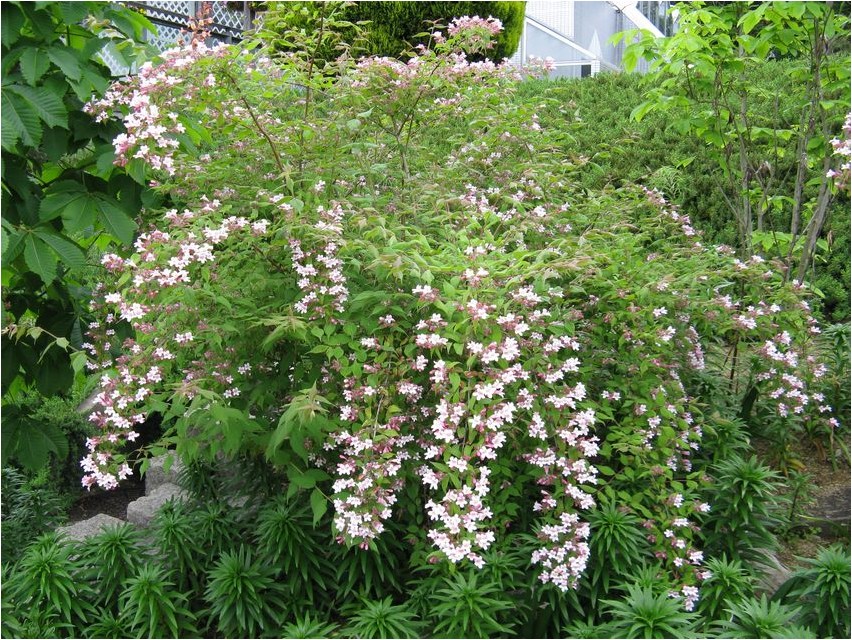
Kolkwitzia (lat. Kolkwitzia) is a monotypic genus of beautiful flowering shrubs of the Linneaceae family. The only species is Kolkwitzia amabilis.
The genus received its name in honor of Richard Kollkwitz, a German professor of botany. In nature, colquitia is found in the mountainous regions of China. Currently, Colquitia is grown as an ornamental crop in countries with temperate climates.
Characteristics of culture
Kolkvitsia is a decorative deciduous densely branched shrub up to 3-3. 5 m high. Young shoots are pubescent, with age they turn red-brown, with peeling bark. As the plants grow, they form a large amount of root shoots. The leaves are bright green, oval or broadly ovate, with pointed tips, paired, opposite, up to 8 cm long. In autumn, the leaves become bright yellow.
The flowers are fragrant, bell-shaped, up to 2 cm long, sit on hairy pedicels, located at the ends of annual shoots. The corolla is five-lobed, yellowish on the inside and pink on the outside. The fruits are small, dry, covered with short bristles over the entire surface. Colquitia blooms in late spring or early summer. Flowering is long and abundant.
Growing conditions
Kolkvitsia is cultivated in regions with cool and temperate climates. The area for growing the crop is preferably sunny or slightly shaded, protected from strong winds. Soils are desirable: drained, fertile, moderately moist, slightly acidic or neutral. Colquitia is quite winter-hardy, able to withstand frosts down t o-30C. In colder winters, young immature shoots of plants freeze strongly, but in the spring they quickly recover.

Reproduction and planting
Colquitia propagates by seeds, horizontal layering, dividing the bush, green and lignified cuttings. Seeds are sown before winter under cover in the form of sawdust, dry fallen leaves and peat. When sowing in spring, the seeds are stratified. Stratification is carried out according to the following scheme: three months are kept in moist sphagnum or sand at room temperature and three months at a temperature of 3-5C. After stratification, the seeds are treated with concentrated sulfuric acid for 10 minutes.
Among vegetative propagation methods for Kolkwitzia, cuttings are the most common. Semi-woody cuttings are taken in the fall and stored in a basement or cellar until spring. In March, the cuttings are planted in boxes, which are then placed in a greenhouse. Rooted cuttings are planted in open ground a year later. Green cuttings are propagated in midsummer. It”s important to remember that green cuttings have limited winter hardiness and are susceptible to severe frost damage during their first winter, sometimes even dying.
Propagation by horizontal layering is also effective. Young shoots are bent to the ground, buried, and secured with wooden staples. It”s recommended to make cuts or tie them with wire. The soil is regularly moistened, and when adventitious roots and new shoots emerge from the buds, the layers are trimmed with pruning shears or another sharp object and planted in the ground or a greenhouse for further growth.
It is best to plant Kolkwitzia seedlings in the spring, after the soil has warmed. Prepare the planting hole in the fall; its depth and diameter should be approximately 50-60 cm. A mound of sand and humus should be formed at the bottom of the hole. Drainage should be provided in heavy soils. Plant the seedling in cloudy weather or in the evening. Trim any excessively long roots with pruning shears or a knife, and then lower the seedling into the hole. Carefully fill all voids with soil and water thoroughly. After planting and watering, the soil around the trunk should be mulched with bark, sawdust, wood chips, or any other natural material. Mulch will help retain soil moisture longer and protect the Kolkwitzia roots from overheating, and from severe frosts in winter.
Care
Kolkwitzia responds well to mineral and organic fertilizers. Early spring or early summer is the best time to apply fertilizer. Also, with the onset of warm weather, but before the sap begins to flow, sanitary pruning is performed, which involves removing frozen and dry branches. After flowering, slightly shorten the Kolkwitzia”s faded shoots. Mulch in the spring and re-mulch in the fall to prepare the plant for winter. Young plants are covered with non-woven material or kraft paper for the winter. Watering, weeding, and loosening the soil in the area around the stems are essential; these procedures are performed as needed.