Sugar apple
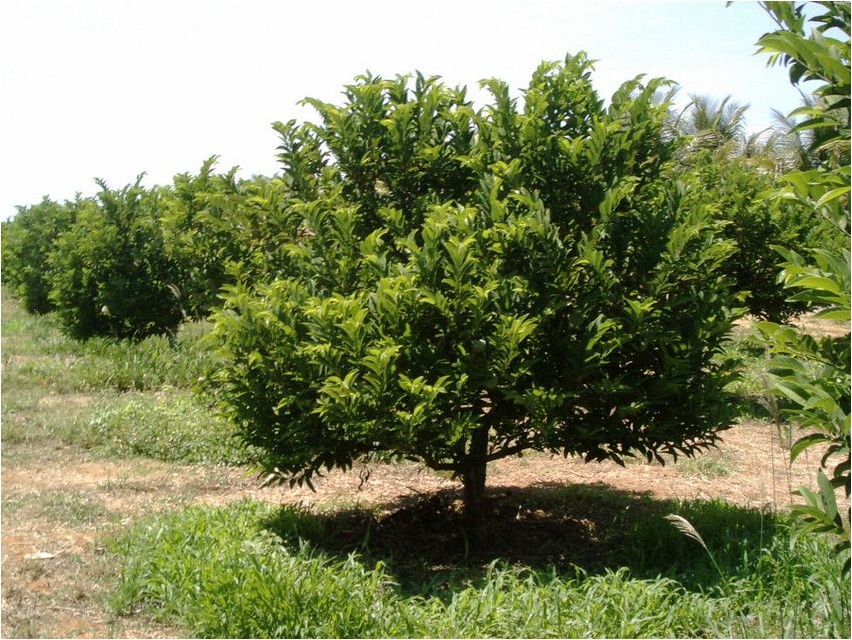
Sugar apple (lat. Annona squamosa) is a fruit tree, also called Annona squamata.
History
Unfortunately, humanity does not have accurate information about the appearance of Annona squamosus. We can only assume that the birthplace of this peculiar fruit is South America.
Around the end of the 16th century, the sugar apple was brought to India by the Portuguese. By that time, this crop was already very actively cultivated in Indonesia and began to spread further — to the Hawaiian Islands, Egypt, the Palestinian lowlands, as well as to tropical Africa, Australia, Polynesia and Southern China.
Currently, Annona scalata has gained unprecedented popularity in Brazil — there it can be found on almost every corner.
Description
The sugar apple is a tree reaching three to six meters in height, endowed with two-row leaves that emit a fairly strong aroma when crushed. They usually grow from five to fifteen centimeters in length, and from two to five centimeters in width.
The fragrant flowers of Annona scalata, located along the branches, are distinguished by their oblong shape, reach a length of 2. 5 to 3. 8 cm and have a pair of inner and outer petals.

The average length of the rounded (however, sometimes they can be conical or oblong) complex fruits of Annona squamosus is about ten centimeters. The lumpy skin of the fruit consists of several protruding segments and is distinguished by a grey-green, bluish-greenish or pale green color. And the fibrous, creamy, whitish pulp inside each fruit is always very sweet, juicy and fragrant. In addition, inside the fruit you can find from two to six dozen shiny black seeds. As for the average weight of the fruit, it is usually 300 — 350 g. As a rule, the harvest of sugar apples begins in June and ends in September.
Where does it grow
The sugar apple is actively cultivated in Central and South America, as well as in Polynesia, Australia, Africa, Southern China, Indonesia, India, the Philippines and the Antilles.
Application
The pulp of ripe fruits is eaten. Immediately before eating, the rough skin of the fruit must be opened, after which the pulp is divided into segments and eaten, spitting out the seeds. Quite often, the juicy pulp of sugar apples is used to prepare soft drinks and a wide variety of desserts.
The kernels of Annona squamosus seeds contain from 14 to 49% non-drying oil, which can be safely used in soap production as an alternative to peanut butter. And after proper treatment with alkali, this oil can also be used for food purposes.
From the leaves of this plant, extremely high-quality essential oil is obtained, enriched with sesquiterpenes and terpenes.
The sugar apple also plays an important role in folk medicine. A decoction of its leaves is an excellent antipyretic and tonic. And unripe fruits, which have astringent properties, as well as a decoction of roots or bark, are widely used for dysentery. Unripe fruits are used in El Salvador for diarrhea, and the pulp of ripe fruits in India is applied to tumors. And the Mexicans put leaves of Annona scalata in the nests of laying hens and rub the floors with them — their rather strong aroma can perfectly repel lice.
Harm
Having a rather pungent taste, the seeds of Annona Scalyata are poisonous — poisoning with them can lead to the most unpredictable consequences. And if the juice of this plant gets into the eyes, a person can go blind.