Pasque Flower
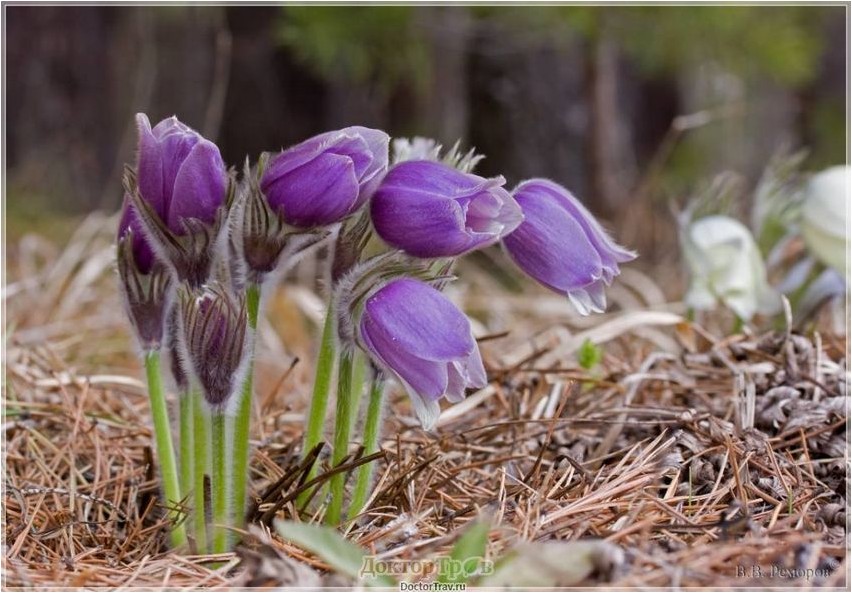
Pasque Flower is a member of the buttercup family. Its Latin name is Pulsatilla patens (L.) Mibb. (P. litifolia Rupr., Anemone patens L.).
The family name of Pasque Flower itself is Ranunculaceae Juss.
Description of Pasque Flower
Pasque Flower is a perennial herbaceous plant that can reach a height of forty-five centimeters. This plant grows annually from a well-developed, vertical rhizome, colored dark brown. At the very base of the stem, a basal rosette of compound leaves, both bipinnate and tripinnate, forms. The leaf lobes of Pasque Flower are linear and initially densely pubescent. The stem leaves of the pasque flower are also long and simple and linear. They can be either pubescent or fused at the base. This plant will bloom as soon as the snow melts. From the thick rhizome of the pasque flower, first white, then blue-violet or yellowish bell-shaped flowers emerge. These are borne on fairly long, hairy stems, approximately thirty centimeters long. The leaves appear somewhat later.
In the wild, the pasque flower is found in Western Siberia, Ukraine, and European Russia. This plant prefers steppes, meadows, riverside areas, dry, sunny limestone slopes, shrub thickets, and sparse pine and mixed forests. This plant can grow singly or in groups. Description of the medicinal properties of Pulsatilla patula
Pulsatilla patula has very valuable medicinal properties, and it is recommended to use the roots and entire aerial parts of this plant for medicinal purposes.
These valuable medicinal properties are attributed to the plant’s content of anemonin, gamma-lactone, and saponins, while the roots and rhizomes of Pulsatilla patula contain triterpene saponins. The aerial parts of this plant contain traces of coumarins, and the flowers contain the anthocyanglycoside delphinidin.
Pulsatilla patula has very valuable antibiotic and antibacterial properties, and this plant also has an abortive effect.

An infusion made from the herb Pulsatilla is recommended for internal bleeding, general weakness, fever, rheumatism, tuberculosis, paralysis, alcoholism, epilepsy, radiculitis, and various gynecological and venereal diseases. An infusion made from the leaves of this plant is indicated for neuroses. A decoction made from the roots of Pulsatilla is used as a poultice for tumors and cuts, and the juice of this plant is used for burns.
In Tibetan medicine, an infusion made from the herb Pulsatilla is quite common. It is used for malnutrition, and externally, this remedy is used to treat purulent wounds.
It should be noted that Pulsatilla is not only an ornamental plant but also a poisonous one. For this reason, extreme caution should be exercised when handling this plant, and such preparations are strictly contraindicated for use in patients with gastritis and nephritis. When used correctly, this remedy can be quite effective.
Pulsatilla or Pasque Flower