Mallow
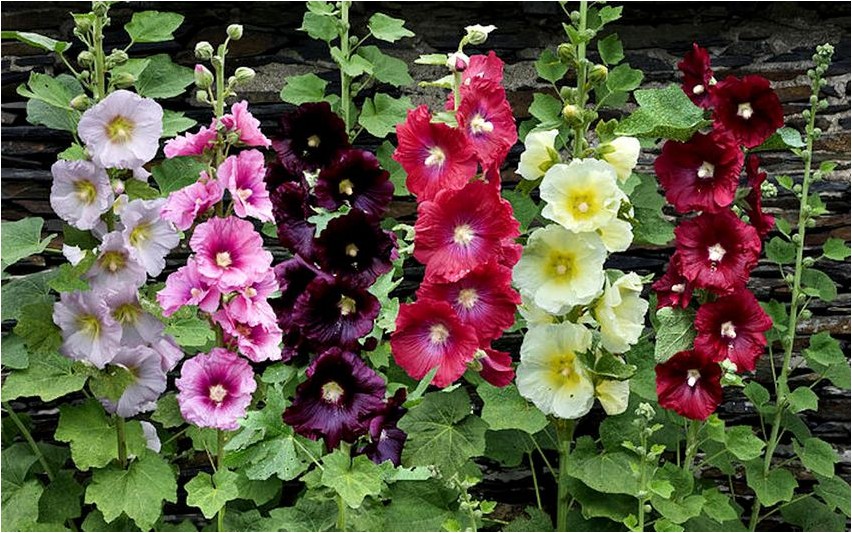
Mallow (lat. Malva) – flower crop; annual and perennial plant of the Malvaceae family. Another name is Mallow.
In nature, mallow is found in Europe, Asia Minor, North America and North Africa. Currently there are about 25 species.
Characteristics of culture
Mallow is a herbaceous plant with woolly-pubescent stems 30-200 cm high. The leaves are quite large, rounded-toothed, five or seven lobed or incised, with a heart-shaped base, located on petioles. The flowers are simple or double, 1-5 each in the leaf axils; in some species the inflorescences are collected in racemes. Flower colors can be very diverse, satisfying even the most sophisticated tastes. Petals are oblong, obovate, deeply notched, with three longitudinal stripes. Mallow blooms in June-August.
Biennial and perennial mallows bloom only in the second year after sowing. In the first year, the plants form a basal rosette of wrinkled round or heart-shaped leaves with curly notches. In the second year, the plant throws out a long, tall stem, on which flowers are subsequently tied. The flowers bloom from top to bottom and occupy most of the stem. After flowering, mallow forms seed pods consisting of numerous small fruits collected around a peduncle. The seeds ripen in 3-4 weeks, and they are collected when the boxes turn yellow.
Growing conditions

Mallow is a light-loving and drought-resistant plant; it prefers intensely lit areas with low groundwater levels. Soils for growing crops are desirable to be drained, permeable, fertilized with humus with a high nitrogen content and without stagnant water.
Mallow has a negative attitude towards areas not protected from wind and drafts. In shaded areas the plant develops poorly and practically does not bloom. Mallows cannot be transplanted because they have a powerful root system, the taproot of which goes 50-100 cm deep.
Reproduction and planting
Mallows are propagated by seeds and cuttings. Sowing of seeds is carried out in May-June. Some gardeners grow the plant through seedlings; in this case, mallow is sown in March. Seedlings are planted in open ground in early June. The seed method is one of the simplest and most effective methods of growing; moreover, mallow is a cross-pollinated plant, which means that when planting several species, you can collect seeds that will absorb the characteristics of both “parents”. Crops are often propagated by cuttings. Planting material is cut from numerous root shoots that appear near the stems of mallow in the summer.
Care
As mentioned above, mallow is a drought-resistant plant, capable of extracting moisture independently from the deep layers of the soil. The crop needs rare and abundant watering, but without waterlogging. Mallow requires systematic weeding, loosening and full fertilizing with complex mineral fertilizers. Don’t forget about preventive treatments and pest and disease control. Mallow is a tall plant; a gust of wind can simply break it, so it is recommended to tie it to a support. After flowering, the plants are pruned. Biennial and perennial mallows are mulched with peat or humus for the winter.
Application
Mallow is a simple plant, but at the same time so charming. This is a favorite flower crop of older people. In ancient times, mallow was often planted in front gardens and garden beds, but professional flower growers did not favor this plant. Today, the attitude towards this wonderful flower has changed dramatically, and mallow has become a full-fledged decoration of parks and gardens.
Mallow is used in group plantings along paths, on edges and in the center of flower beds. The plant looks impressive in the background of mixborders. Mallow is also suitable for making living bouquets. The culture is combined with sunflowers, cosmos, rudbeckia, phlox, etc. Mallow is often used to create hedges or screens for low buildings and fences that are not particularly decorative.
Some forms are used as container plants; they are grown in pots, vases and large flowerpots that will decorate a recreation area (patio, terrace, balcony). Mallows have also found their use in folk medicine. Infusions of the plant are used internally and externally for hoarseness and severe cough. Mallow root is also beneficial.





