Buttercup multiflora
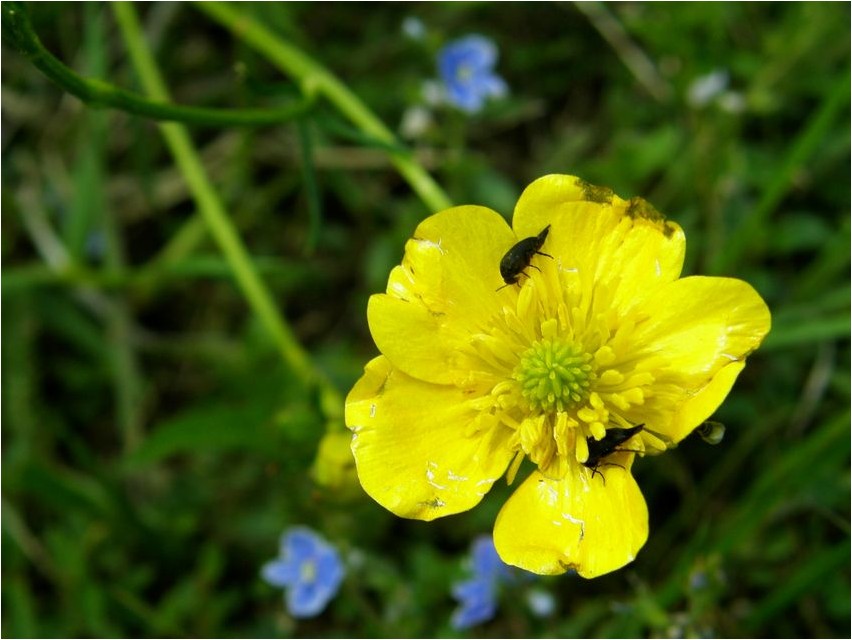
Buttercup (Ranunculus polyanthemus) is a member of the buttercup family. Its Latin name is Ranunculus polyanthemus L. As for the family name itself, the Latin name is Ranunculaceae Juss.
Description of Buttercup
Buttercup (Ranunculus polyanthemus) is a perennial herbaceous plant with a shortened rhizome. Its stem is furrowed, erect, and branched. It can be either bare or covered with erect hairs halfway up the stem. The height of this stem ranges between thirty and eighty centimeters. The basal leaves of this plant have rather long, scalloped, hairy petioles and a blade that is rounded to heart-shaped. These leaves will be three- or five-partite, divided into lanceolate, elongated, and slightly widening lobes, which in turn will be incised-toothed. The upper stem leaves of the multi-flowered buttercup are two- or four-partite, divided into serrated or linear-lanceolate, entire marginal lobes. The leaf blades of this plant are endowed with appressed hairs on both sides. The flowers of the multi-flowered buttercup are typically numerous, and their diameter is about two to three centimeters. The sepals of this plant are obtuse and ovate, and they will also be endowed with erect hairs along the margins. This plant has only five to seven petals, and they will be colored bright yellow. The receptacle of the multi-flowered buttercup will be hairy. The fruitlets of this plant are three and a half millimeters long, naked and laterally compressed, and most often have a straight, short beak. The multi-flowered buttercup blooms from May to June. In the wild, this plant is found in many regions of European Russia, Belarus, Ukraine, southern Eastern Siberia, the mountains of Central Asia, and Western Siberia. It prefers clearings and forest edges, light forest clearings, dry floodplain and upland meadows, and most commonly forest-steppe and forest belts. Sometimes this plant grows among fields, on embankments, and in secondary habitats along roadsides.
Description of the medicinal properties of multi-flowered buttercup
Buttercup multiflorum is endowed with very valuable healing properties, and it is recommended to use the entire above-ground part of this plant for medicinal purposes. It is recommended to harvest such raw materials throughout the entire flowering period of this plant.
The presence of such valuable healing properties should be explained by the content of the glycoside ranunculin, ascorbic acid, tannins, saponins and carotene in this plant. The flowers of Ranunculus multiflorum contain carotenoids, and the fruits will contain essential oil.
Based on this plant, preparations are made that have the ability to cause severe irritation of the mucous membrane of the entire digestive tract. It is noteworthy that when such drugs act on the heart, the amplitude of heart contractions will decrease, and they will also cause a strong narrowing of the lumen of blood vessels.
An aqueous infusion prepared from a fresh plant is recommended for use in small doses as a tonic, and is also used for headaches and stomach pain. Externally, the fresh herb of this plant is used for wounds, boils, neuralgia, gout, rheumatism and headaches. It should be noted that this plant is poisonous and for this reason considerable care should be taken when handling this plant.
Buttercup multifloral 600 medicinal plants





