Grumichama
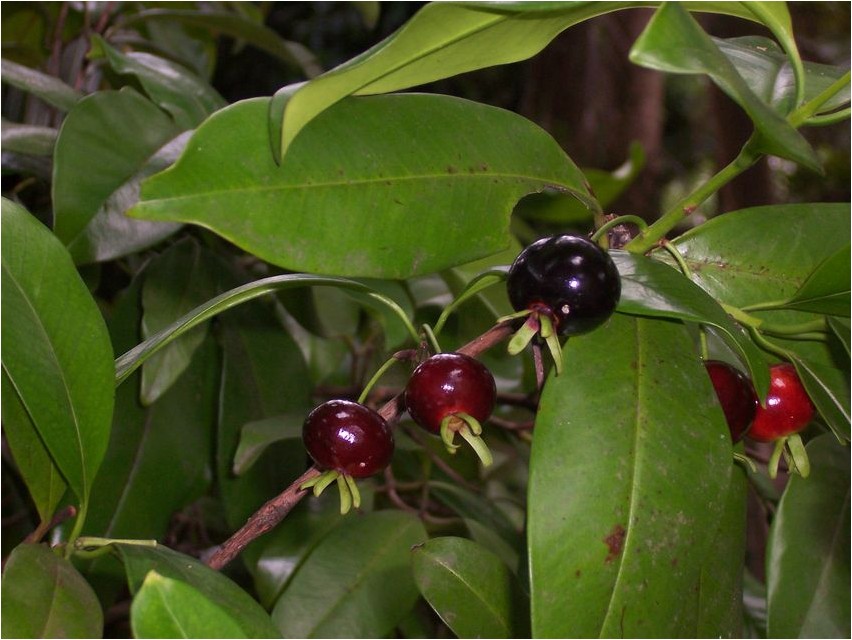
Grumichama (Latin: Eugenia brasiliensis) is a fruit tree belonging to the Myrtaceae family. It is commonly known as the Brazilian cherry.
Description
Grumichama is an evergreen, upright, and slender tree, seven and a half to ten and a half meters tall, with a spreading, spherical crown and oval-oblong, glossy leaves five to six centimeters wide and nine to sixteen centimeters long. The edges of all the leaflets are slightly curved.
The flowers, formed in the leaf axils, have four white petals, four green sepals, and numerous stamens with pale yellow anthers. The flattened fruits of the grumichama range from 1. 25 to 2 cm in width. Their color can range from dark purple (almost black) to bright red. Each fruit is supported by fairly long stalks, approximately one to two centimeters wide. Beneath the thin skin of these fruits lies a reddish or white, juicy pulp containing one to three brownish seeds. The pulp of the grumichama has a pleasant cherry aroma and a wonderful sweet and sour flavor. In Brazil, these unusual fruits ripen from November to February, and in Florida, from April to May.
Where it grows
Both cultivated and wild, grumichama grows in Paraguay and southern Brazil, its native land.
Uses
Grumichama fruits are eaten fresh and are also popular for pie filling. They are also used to make wines, juices, jellies, preserves, and jams.
These amazing fruits have found applications beyond the food industry. Grumichama is a natural vitamin supplement that reduces the risk of a wide range of ailments and boosts immunity. The leaves and bark, which contain essential oils, are used as antipyretics, diuretics, and astringents.

Grumichama fruits also help prevent and speed up the recovery from gastrointestinal diseases. They also have a diuretic effect, albeit a rather weak one.
Thanks to its extremely beautiful crown, groomichama also has high decorative value. These trees are actively used to create hedges, alleys, squares and parks. And in gardening they are grown to prevent soil erosion and for reforestation. Wood is no less valuable — it has found its application in carpentry and furniture production.
The main disadvantage of groomichama is its inability to withstand long-term transportation. That is why it is almost impossible to see this fruit in distant countries.
Growing
Grumichama is a very heat-loving tree that does not tolerate prolonged downpours and temperatures below twenty-four degrees. It grows and bears fruit best in subtropical conditions.
Grumichama is characterized by high shade tolerance, although it also tolerates strong sun very well. The most suitable for planting it will be coastal zones and plains — in elevated areas it is almost impossible to meet this crop. As for soils, groomicama needs acidic, nutritious and well-drained soil. And it usually begins to bear fruit when it reaches four or five years of age.
When growing groomicama, it is important to take into account that its fruits are often affected by harmful fruit flies. In addition, groomicama are quickly eaten by their larvae.
The following plants are planted in the ground: White and Pink guavas, grumichama, jaboticaba.





