Lemon
fruit and berry crops, Ornamental trees and shrubs, Lemon (lat. Citrus limon) is a species of low-growing trees of the Citrus genus of the Rutaceae family.
The homeland of the plant is considered to be China and India, as well as the tropical Pacific islands. Lemon is practically never found in nature. Currently, lemon is cultivated in Uzbekistan, Tajikistan, Azerbaijan, Italy, Greece, Turkey, Spain, Portugal and other countries with warm climates. In Russia, lemon is grown as an indoor crop.
Characteristics of culture
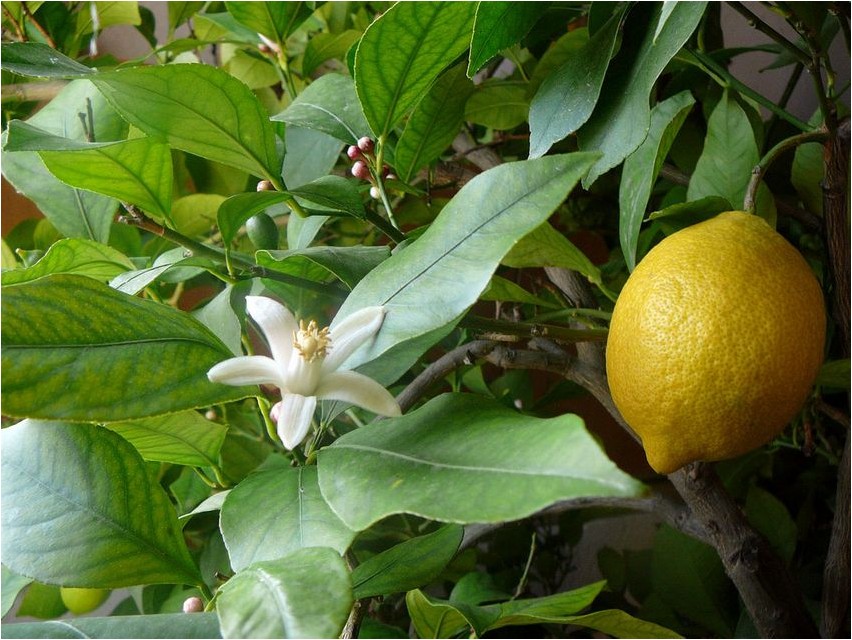
Lemon is an evergreen tree up to 8 m high with a pyramidal or spreading crown and shoots with or without thorns. The bark on perennial branches is gray, with cracks over the entire surface; young branches are smooth, reddish-purple. The leaves are green, entire, leathery, glossy, oblong-ovate or broadly oval, fragrant, up to 15 cm long, pointed at the ends; on the underside – light green, matte. The leaves sit on short winged or wingless petioles.
The flowers are small, paired or single, axillary. The calyx is unclearly toothed, the corolla is five-membered. The petals are cream or snow-white, purple or pink on the outside, bare, and have a pleasant, refreshing aroma. The fruit is oval or ovoid, up to 6 cm in diameter, with narrowed ends, at the top there is a kind of “nipple”, usually light yellow. The crust is difficult to separate, lumpy, containing a huge amount of glands with essential oil. The pulp of the fruit is yellow or yellow-green, very sour. The seeds are white or yellowish, ovoid, sometimes slightly flattened.
Growing conditions
Lemon is a plant that requires heat and light. When growing crops indoors, the optimal air temperature is 15-18C. At low temperatures, lemons lag behind in growth, and buds do not form. Winter temperatures for the plant are 12-13C. Such wintering will have a positive effect on future fruiting.
The location is preferably sunny with diffused light, so western and eastern windows are ideal for lemon. During hot hours, plants are shaded. Air humidity at a temperature of 20C should be 60-70%. When the crop is kept in rooms with dry air, it is attacked by various pests, for example, scale insects and mites.

Reproduction and planting
Lemons are propagated by seeds, cuttings, layering and grafting. Seeds are sown in seedling containers followed by picking or individual pots. Lemon shoots appear after 35-40 days. The seedlings emerge in the phase of 4-5 true leaves; during transplantation, it is necessary to pinch the tap root, otherwise it will curl into rings at the bottom of the container. It is pinching that gives impetus to strong branching. Lemons grown by sowing seeds begin to bear fruit only at 8-12 years of age, and sometimes much later. To accelerate the onset of fruiting, seedlings are grafted. Shoots of fruiting specimens are used as a rootstock.
Most often, lemons are propagated by cuttings. Cuttings are cut from healthy shoots that have not yet become lignified. Each cutting should have 2-3 well-developed buds. The cutting length varies from 8 to 12 cm. Cuttings can be carried out at any time of the year, but spring cuttings give the best results. Root the cuttings in pots filled with garden soil and sand, taken in equal proportions. Good drainage is also required. It is not forbidden to root cuttings in a glass of water, but in this case the container is placed in an intensely lit place.
Cuttings take root in 2-3 weeks (subject to optimal conditions). To speed up the process, cuttings must be treated with growth stimulants. The soil in the pots is regularly moistened, and warm water is used for irrigation. With the appearance of the root system, the young plants are transplanted into pots with a diameter of at least 12-13 cm. The substrate is made up of leaf and turf soil, sand and decomposed manure in a ratio of 1:2:0. 5:1. In the first year, it is advisable to carry out three transshipments without destroying the earthen coma: the first transshipment is carried out in the spring, the second in early summer, the third in the second decade of August.
Care
Watering should be regular. For irrigation, it is recommended to use spring water or water from wells; chlorinated water can harm plants. In winter, the amount of watering is reduced, but the earthen ball should not be allowed to dry out, otherwise the lemon leaves will begin to curl and fall off.
Lemons are fertilized in the first half of summer. Liquid complex fertilizers are used; they increase the sugar content of fruits and also reduce the bitter taste inherent in most citrus fruits grown at home. The older the plants, the more often they need to be fertilized; the frequency of fertilizing is also increased when growing crops under artificial light.
Lemons also need formative pruning. This procedure can be carried out at any time of the year, but in the spring it is preferable. The grafted specimens are given a rounded shape. Anti-aging pruning is carried out no earlier than 14-20 years.