Oxytropis pilosa
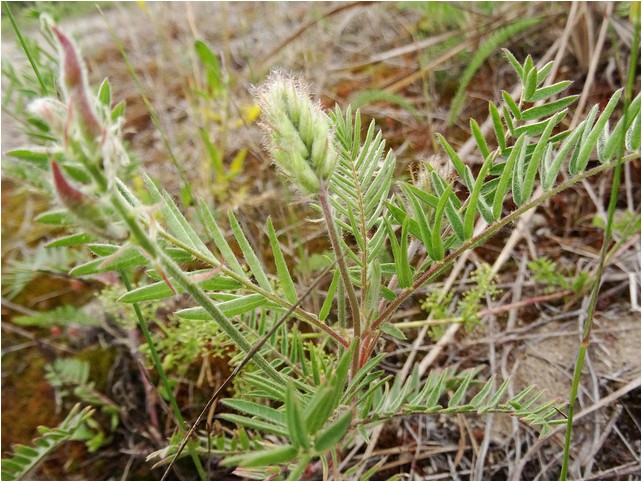
Oxytropis pilosa is a member of the legume family, and its Latin name is Oxytropis pilosa (L.) DC.
The Latin name of the oxytropis pilosa family is Fabaceae Lindl. (Leguminosae Juss.).
Description of Oxytropis pilosa
Oxytropis pilosa is a perennial plant covered in dense white hairs. The stems of this plant can be either erect or ascending at the base. These stems are approximately twenty to fifty centimeters long, thickened, and often reddish. Oxytropis pilosa leaves are approximately five to ten centimeters long, with seven to fourteen paired leaflets. These leaves are oblong, ranging in length from ten to twenty millimeters, and three to five millimeters wide. Notably, the leaves of this plant are hairy on both sides. The peduncles of Oxytropis capillaris are pubescent and longer than the leaves. The racemes are quite numerous and dense, elongated, and oblong-oval. The corolla of this plant is light yellow, and the flag length is twelve to fourteen millimeters. The keel is somewhat shorter than the wings, and the pods are leathery, crowded, and erect in the raceme.
Oxytropis capillaris blooms from May to July. In the wild, this plant is found in Ukraine, European Russia, the Caucasus, Moldova, Central Asia, Belarus, and Western and Eastern Siberia. In terms of general distribution, this plant can be found in Mongolia and Central Europe. Oxytropis pilosa prefers wastelands, mixed-grass meadow steppes, rocky slopes, coastal sands, light forests, forest edges, fallow lands, and shrubby areas, from the plains to the highlands. It should be noted that this plant is poisonous, but it is also very ornamental and a valuable honey plant.
Description of the medicinal properties of Oxytropis pilosa
The hairy plant is endowed with very valuable healing properties, and it is recommended to use the herb of this plant for medicinal purposes. The concept of grass includes flowers, leaves and stems. The presence of such valuable healing properties is recommended to be explained by the content of alkaloids in the roots of this plant, while the herb will contain phenol carbonic acids, alkaloids, coumarins and the following flavonoids: quercetin, mono- and diglycosides of quercetin and kaempferol, as well as astragalin.
A decoction prepared from the herb of this plant is recommended for use for various nervous diseases and fever, while an infusion based on the herb of the herb is used for numerous gynecological diseases.

For neurasthenia, neurosis and vegetative dystonia, you should use a very effective remedy based on this plant: to prepare such a healing remedy, you will need to take one teaspoon of dry crushed grass of the hornwort plant per glass of water. It is recommended to boil the resulting healing mixture based on this plant for about three to four minutes, then leave this mixture to infuse for one hour, after which it should be filtered very carefully. Take the resulting medicinal product based on the capillary plant two to three times a day, one tablespoon.