Norichnik knotty
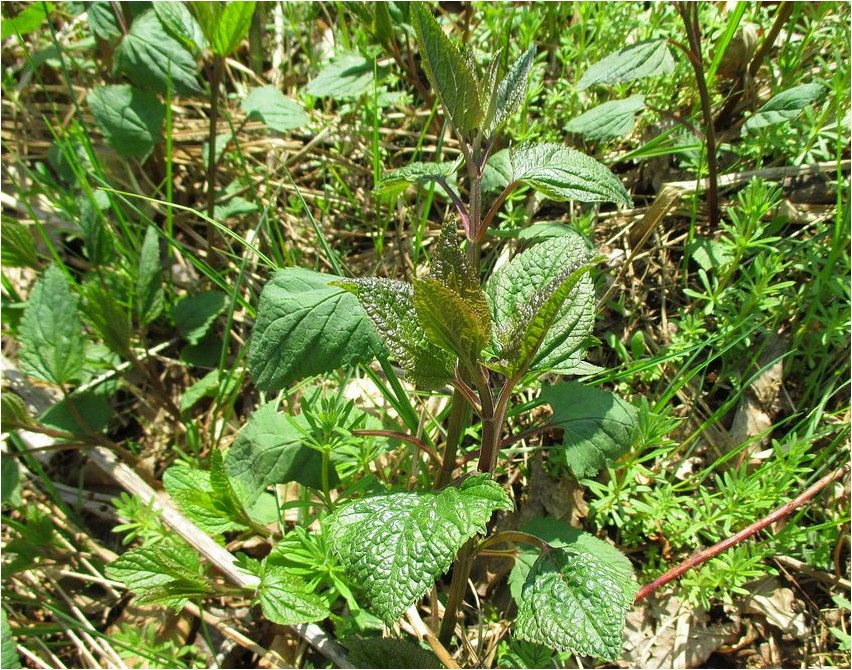
Scrophularia nodosa L. is one of the plants of the family called Noricaceae; in Latin the name of this plant will be as follows: Scrophularia nodosa L.
As for the name of the knotweed family itself, in Latin it will be like this: Scrophulariaceae Juss.
Description of the knotweed
Norichnik knotty is a perennial herbaceous plant, the height of which will fluctuate between fifty and one hundred and fifty centimeters. Most often, such a plant is naked and will be endowed with a tuberous-thickened rhizome, which in turn will be straight. The stem of this plant is tetrahedral, the petiolate leaves will be opposite, and when rubbed, an extremely unpleasant odor will arise. The lamina of the leaf of the nosychium nodosum can be either elliptical or heart-shaped-ovate; the length of such a lamina will be about five to fifteen centimeters, and the width can reach twenty-eight centimeters. The flowers of Nora nodusa are located on glandular pedicels, which in turn are located in a pyramidal paniculate inflorescence. The length of the calyx of this plant reaches three millimeters, and the lobes will be ovoid and obtuse. The length of the corolla of the nosywort will be about seven to nine millimeters, it will be more or less two-lipped, with the lobes of the upper lip being twice as long as the lateral ones, and such a corolla will be colored in greenish-brown tones. The staminode of this plant is obverse kidney-shaped and notched. The fruit of the nosychium nodosum is a bare, pointed capsule, which will also be more or less spherical.
This plant blooms throughout the summer. Under natural conditions, the nocturnal squirrel is found in the European part of Russia, Ukraine, Belarus, the Caucasus, Western and Eastern Siberia. For growth, this plant prefers gardens, meadows, places along roads and ditches, arable lands, places near dwellings, coniferous, deciduous and coniferous-deciduous forests. This plant is ornamental and poisonous.
Description of the medicinal properties of Norichina nodosum
Norichnik knotty is endowed with very valuable healing properties, and for medicinal purposes it is recommended to use rhizomes, grass, seeds, petals and juice of this plant. The term grass includes flowers, stems and leaves.
The presence of such valuable medicinal properties can be attributed to the presence of saponins, sucrose, stachyose, iridoids, phenolic acids, flavonoids, coumarins, and many other beneficial substances in this plant. An aqueous extract of this plant has hemostatic properties, but is toxic to some insects. The rhizomes of the nodular figwort have anthelmintic, laxative, and emetic properties. A decoction prepared from the rhizomes of the nodular figwort is recommended for both internal and external use as an anti-inflammatory agent and is also used for scrofula, itchy dermatoses, furunculosis, goiter, lymphadenitis, and hemorrhoids.

When cut or crushed, this plant is used as a very effective wound-healing agent for various tumors, snake bites, and suppurations. Juice or a decoction prepared from the rhizomes of this plant, both on its own and in mixtures, is recommended for ulcers, infiltrates, and cancer. A tincture based on the nodular figwort is recommended for otitis, malaria, lipomas, and articular arthritis. It is noteworthy that an experiment has proven that the tincture of this plant has sedative properties.





