Forest mallow
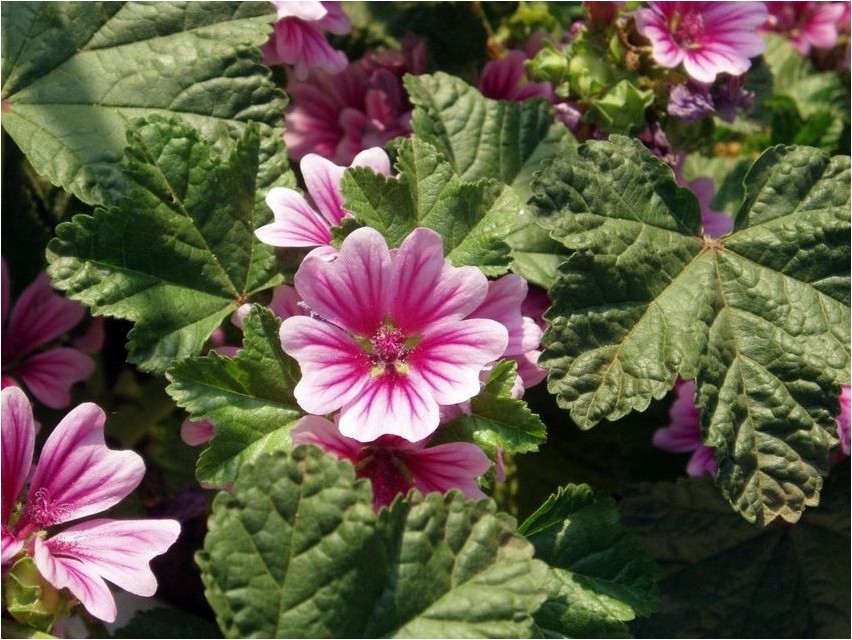
Forest mallow is one of the plants of the family called malvaceae; in Latin the name of this plant will be as follows: Malva silvestris L.
As for the name of the forest mallow family itself, in Latin it will be: Malvaceae Juss.
Description of forest mallow
Forest mallow is a biennial or perennial herbaceous plant, the height of which can reach approximately one hundred and one hundred and twenty centimeters. The stem of this plant is pubescent, straight and poorly branched. The leaves of the forest mallow will be round-heart-shaped and long-petiolate, pubescent and crenate-toothed, and such leaves will be five to seven-lobed. The flowers of this plant will be quite large in size, they are colored in pink-violet tones, and there will be about five to ten of these flowers in the axils of the leaves and on densely pubescent pedicels. The fruit of the forest mallow is fractional; it breaks up into ten single-seeded and wrinkled fruits.
This plant blooms from May to June. Under natural conditions, forest mallow is found in Central Asia, Ukraine, the Caucasus, Belarus and the European part of Russia. For growth, this plant prefers places near dwellings and along roads, gardens, wastelands, river banks in flat and foothill zones, as well as sparse forests on the edges.
Description of the medicinal properties of forest mallow
Forest mallow is endowed with very valuable healing properties, and it is recommended to use the roots, leaves and flowers of this plant for medicinal purposes. Flowers should be harvested at the stage of their budding at the moment when they are already colored pink, while it is recommended to dig up the roots in the autumn.
The presence of such valuable healing properties is recommended to be explained by the content of tannins, mucus, carotene, sugar, ascorbic acid, malvina coloring matter and other useful substances in this plant.

The flowers and leaves of this plant are endowed with very effective laxative, anti-inflammatory, expectorant and enveloping properties.
An infusion prepared from the leaves and flowers of the forest mallow is recommended for use for emphysema, cough, pneumonia, bronchitis, renal colic, sore throat, stomatitis, chronic pancreatitis, as well as for various inflammatory diseases of the gastrointestinal tract.
Forest mallow should be used externally in the form of ointments and poultices for hemorrhoids, burns and skin irritation. Hot baths based on this plant will be effective for various diseases of the spleen. As for homeopathy, the essence from a fresh flowering plant has become quite widespread.
A decoction and infusion prepared from this plant can be used as a gargle for inflammation of the larynx and throat, especially for severe hoarseness. It is noteworthy that the flowers of this plant are present in the composition of the breast and emollient collection, and in addition, the leaves of the forest mallow are quite acceptable to eat.
As for Tibetan medicine, here this plant is used for diarrhea, urinary retention, as well as for various kidney diseases that will be accompanied by high fever.
For chronic pancreatitis, take two tablespoons of crushed raw leaves and flowers of this plant in a glass of boiling water, boil for six minutes and filter. Take this healing remedy based on forest mallow four times a day, one-fourth of a glass before meals.





