Fir
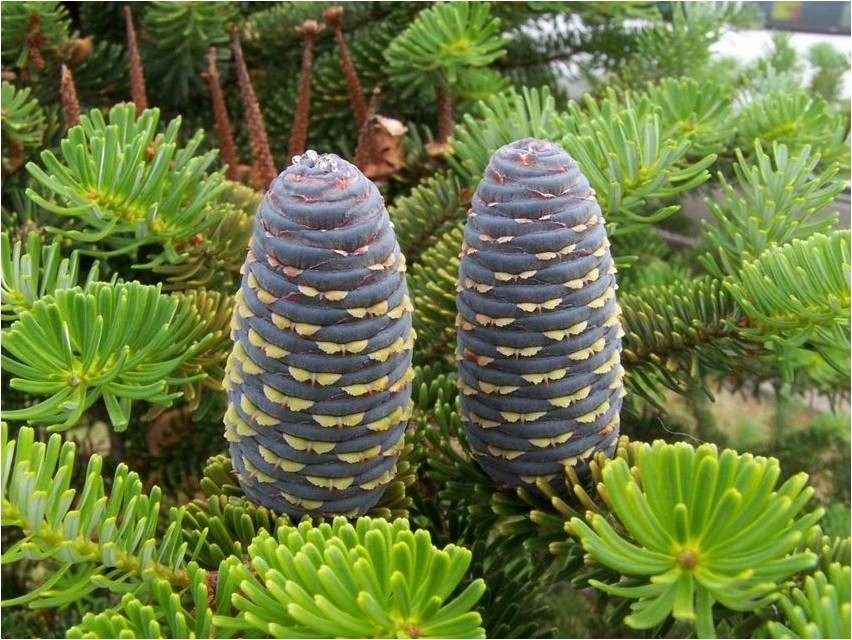
Fir (lat. Abies) is a coniferous tree of the Pine family (Pinaceae). Under natural conditions, fir grows in mountainous areas of the subtropical and temperate zones of Eastern and Central Europe, Siberia, the Far East, North America, North Africa, as well as in Korea, China, the Himalayas and Japan.
Currently, about 40 species of fir are known, but not all of them are used in landscape design, since some specimens reach a height of 60 m.
Characteristics of culture
Fir is a powerful evergreen tree with a beautiful cone-shaped crown starting at the base of the trunk. Fir is one of the most noble plants of the Pine family, valued for the beauty of its needles and symmetrical pyramidal shape. The needles of the plant are very fragrant, dark green in color with two whitish stripes on the bottom. Some species have blue-green or gray-green needles.
The flowers of the crop are monoecious and inconspicuous. Male flowers are presented in the form of earrings, composed of a large number of cones, bearing two pollen sacs from below, female flowers in the form of erect cones, on the stems of which narrow and long covering scales are formed. Fir cones develop over several decades and are located at the top of the tree; they do not completely fall off, only gradually after the scales have matured. The root system of the plant is quite powerful and taprooted.
Growing conditions

Fir is a shade-tolerant crop, but it develops best and forms a typical crown shape in well-lit areas. Young plants need shading. Fir is moisture-loving and prefers cool areas, although some forms can easily tolerate elevated temperatures.
The crop is sensitive to air pollution and demanding on soil conditions. It is advisable to grow fir on moderately moist, fertile, loose, drained soils with a neutral pH reaction. The plant has a negative attitude towards waterlogged, saline, acidified soils.
Reproduction, planting and transplanting
Fir trees are propagated by seeds, cuttings, layering and grafting. Sow seeds in spring or autumn under cover. Fir seeds require preliminary stratification. During the first 5-10 years, plants grow very slowly, later the speed of development increases significantly. Only freshly harvested seeds should be used for sowing. It is believed that the seed method does not allow preserving the characteristics of the mother plant, so most often fir is propagated by cuttings.
Cuttings are cut in the spring before the buds awaken exclusively from young plants. Cuttings are planted in open ground until rooting. The optimal temperature for rooting planting material is 20-23C. Rooted cuttings are transplanted to a permanent place, the distance between plants should vary from 2. 5 to 5 m. The crop is rarely propagated by layering, since this method does not guarantee a plant with a beautiful cone-shaped shape; in most cases, fir trees grow creeping and lopsided.
Fir is transplanted in early spring before the buds swell or in autumn. Important: it is not recommended to bury the root collar. At a young age, fir can easily tolerate transplantation, but adult plants have a negative attitude towards this procedure. After transplantation, plants require abundant watering and regular spraying.
Care
Fir care involves standard procedures for all ornamental shrubs and trees. The crop needs watering, which is carried out 2-3 times per season (at the rate of 15-20 liters per plant). During drought, the plant requires spraying. The trunk circles of young fir trees should be loosened regularly, and it is also advisable to mulch them with sawdust, peat or wood chips in a layer of 5-10 cm.
In the spring, sanitary pruning is carried out: dry and damaged branches are removed. The crop does not need formative pruning. Feeding with complex mineral and organic fertilizers is carried out only for young specimens. Some types of fir are not frost-resistant; they require winter shelter, for example, with spruce branches or lutrasil.
Application
Fir is a highly ornamental plant; it fits perfectly into the landscape design of even small garden plots. Most often, fir trees are used in group, solitary and alley plantings. The crop is also grown near water bodies. Some forms are used to create uncut hedges. Dwarf fir looks ideal in rocky gardens — rockeries and rock gardens.
Goes well with other low-growing conifers, perennials and ground-blooded plants. Fir also harmonizes with maples, white-trunked birches, spruce, pine and larch. Fir needles are not used as mulch or winter shelter, since they are quite dense and do not allow the required amount of sunlight to pass through to plant roots.





