Mandarin Japanese
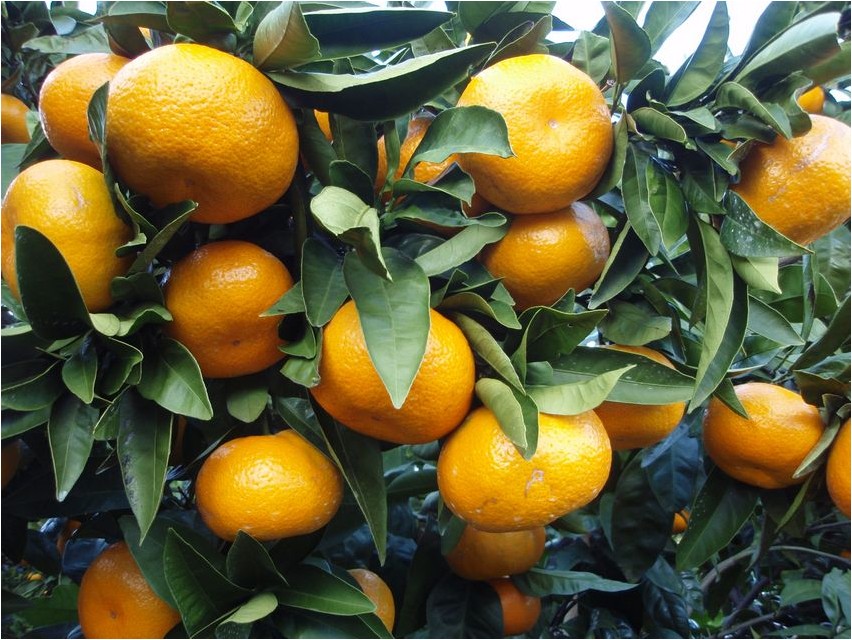
Japanese mandarin is one of the plants of the family called Rutaceae; in Latin the name of this plant will be as follows: Citrus unschiu Marc.
As for the name of the Japanese mandarin family itself, in Latin it will be: Rutaceae Juss.
Description of Japanese mandarin
Japanese mandarin is a small spreading tree whose height will reach four meters. Such a tree is endowed with gray bark and evergreen leathery leaves, as well as small fragrant flowers, which in turn will sit in the axils of the leaves singly or in groups of two or three. The calyx of this plant will be four to five toothed, the corolla consists of four to five fleshy petals, while the Japanese mandarin has many stamens and they are endowed with underdeveloped anthers, while there is only one pistil.
The fruits of this plant are rounded and flattened, they are endowed with a slightly detachable thin aromatic peel, sweet and sour in taste and orange-yellow in color. Japanese mandarin blooms from February to April. In this case, the ripening of the fruits of this plant will occur in October-November. Under natural conditions, this plant will be cultivated in Azerbaijan and on the Black Sea coast of the Caucasus. Moreover, the birthplace of Japanese mandarin is Japan.
Description of the medicinal properties of Japanese mandarin
Japanese mandarin is endowed with very valuable healing properties, and for medicinal purposes it is recommended to use the fruits and peel of ripe fruits of this plant, both dried and fresh. The presence of such valuable medicinal fruits is recommended to be explained by the content of thiamine, vitamins, phytoncides, sugars, citric and other organic acids in the pulp of the ripe fruits of this plant. The peel of this plant will contain hesperidin, taricaxanthin, violaxanthin, beta-carotic, luten and also a large amount of essential oil. Japanese mandarin essential oil contains citral, limonene, citronellal, caprylic and anthranilic acid methyl ester. Actually, it is precisely these elements that will give the characteristic taste and smell to tangerine oil.
It should be noted that the fruits of this plant will be a very valuable dietary product. The fruits of Japanese mandarin will increase appetite and help normalize metabolic processes and strengthen the body, and also help weaken peristalsis. Due to this, such fruits are useful for various diseases of the gastrointestinal tract, which will be accompanied by diarrhea. In the form of compresses, it is recommended to use fresh juice of this plant, which is endowed with the ability to kill some fungi that will cause various skin diseases, including microsporia and trichophytosis. In addition, for such diseases, repeated rubbing of the juice of a slice of this plant into the areas of the skin affected by the fungus is performed.

A bitters tincture is prepared from the peel of this plant, which is recommended for improving digestion and appetite, as well as improving phlegm separation and mitigating cough. An infusion and decoction prepared from the dried peel of Japanese mandarin in water is recommended to drink to improve expectoration of phlegm and soften cough in cases of pneumonia, tracheitis and bronchitis. As for Chinese traditional medicine, here this plant is quite widespread: the peel of ripe fruits is used for whooping cough, pneumonia, bronchitis, tracheitis, and also as a remedy that will help improve digestion.
The fruits of Japanese mandarin are also widely used in cooking: compotes, jam, candies and marmalade are prepared from them.