Loosestrife
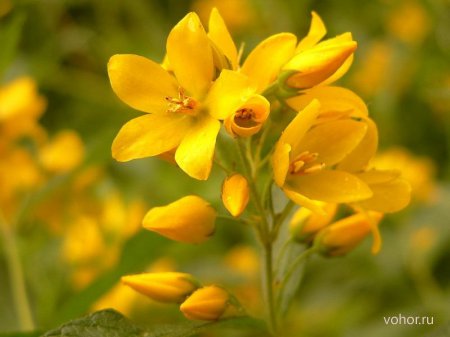
Loosestrife or lysimachia is related to perennial plants. There are species of loosestrife with erect or creeping shoots (coin-like). The flower is distinguished by its hardiness, impressive flowering, rapid spread and unpretentiousness in cultivation. In addition, some types of plants have medicinal properties.

types of loosestrife
Spot is a perennial plant reaching a height of about 60 cm. It is distinguished by light yellow inflorescences. Flowering occurs in June-July.
The ephemerum reaches a height of up to 90 cm.
The crowded flower reaches a height of up to 40 cm. The canary-colored flowers are collected in umbrellas.
Crimson — perennial plant up to 90 cm high. The inflorescences are collected in a spike, the flowers are dark red in color.

Monetata is a perennial plant reaching a height of approximately 30 cm. The flowers are yellow.
Care and cultivation of loosestrife
Loosestrife chooses sunny areas; some species grow much better in light shade. Regardless of the species, they are unpretentious to soils and grow much better on moist soils. Water abundantly and systematically. It does not need fertilizing, except when grown on poor soils. Then the flower is fed with complex mineral fertilizers for any 2 weeks from May to July.
In autumn, the stems of the plant are cut back to the very base, except for the coin-shaped stems, the stems of which are not cut off. Loosestrife is cold-resistant and therefore has no need for winter shelter.

reproduction
loosestrife is propagated by dividing rhizomes, lateral cuttings, shoots, and seeds. When propagated by seeds, it will bloom only 2-3 years after sowing. Sowing seeds is done in spring or autumn immediately in open ground and in a stable place. They are also propagated by seedlings. In the interests of extracting seedlings, seeds are sown in March or April. Seeds are germinated at a temperature within 18-22 degrees. In early May, plants are planted in open ground at a distance of 15-20 cm from each other.
The division of rhizomes is carried out in the spring, before the plant begins to grow, or in the fall, in most cases in early September.