Dandelion Mongolian
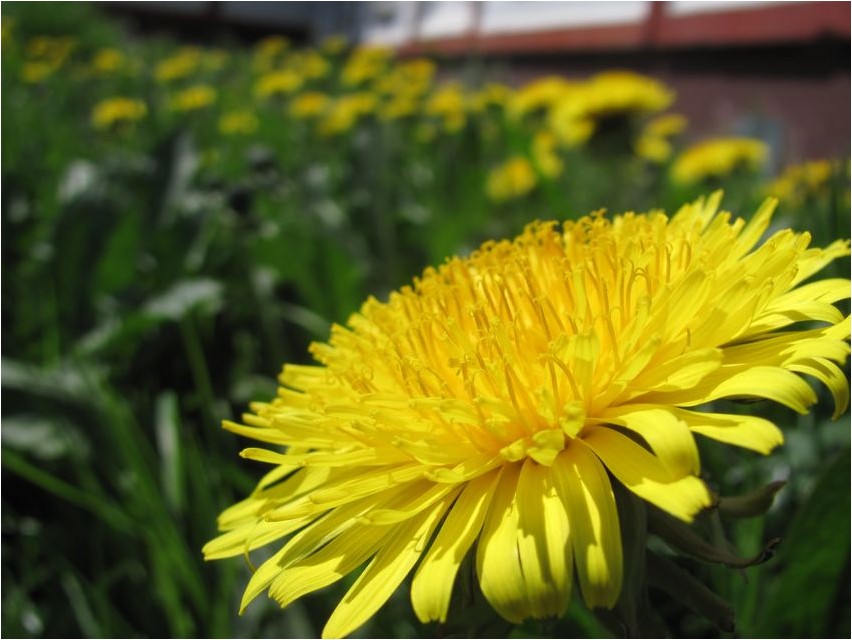
Mongolian dandelion is one of the plants of the family called Asteraceae or Asteraceae; in Latin the name of this plant will be as follows: Taraxacum mongolicum Hand-Mazz.
As for the name of the Mongolian dandelion family itself, in Latin it will be like this: Asteraceae Dumort. (Compositae Giseke).
Description of Mongolian dandelion
Mongolian dandelion is a perennial herbaceous plant whose height will vary between five and thirty centimeters. This plant will be endowed with a rather thick root, the length of the leaves of the Mongolian dandelion will be about five to fifteen centimeters, while their width will be equal to one to four centimeters. Such leaves are most often pinnately divided, they are colored in light green tones and are endowed with sparse cobwebby pubescence. The flower arrows of the Mongolian dandelion will be identical in length to the leaves or may be slightly longer than them. Such flower arrows are endowed with quite abundant loose cobwebby felt. The marginal flowers are painted in light yellow tones, and on the outer side of the reeds they will be endowed with stripes of pinkish-violet color. The achenes of this plant are endowed with a few longitudinal furrows and are colored in light brown tones.
Mongolian dandelion blooms from May to June. Under natural conditions, this plant is found in the Daursky and Leno-Kolyma regions of Eastern Siberia, as well as in the Amur region and Primorye in the Far East. For growth, Mongolian dandelion prefers pebbles, grassy slopes, meadows, and places near roads in the lower and middle mountain zones. It is noteworthy that this plant is a very valuable honey plant.
Description of the medicinal properties of Mongolian dandelion
Mongolian dandelion is endowed with very valuable healing properties, and for medicinal purposes it is recommended to use the roots and aerial parts of this plant along with the inflorescences. The presence of such valuable healing properties should be explained by the rubber content of this plant.
In folk medicine, this plant is quite widespread. Traditional medicine uses the roots of Mongolian dandelion as a diaphoretic, restorative, antipyretic, and tonic, and is also used for anorexia, cancer, tumors, and various stomach ailments. The crushed roots of this plant are used for tumors, while in medicinal infusions, these roots are used for diabetes.

A decoction made from Mongolian dandelion roots is recommended for skin diseases, rheumatism, and as a hemostatic, detoxifying, and astringent agent. It is noteworthy that this plant can exhibit very effective fungicidal activity. The juice of Mongolian dandelion acts as a lactogenic agent. Infusions and decoctions prepared from the aerial parts of Mongolian dandelion are recommended for arthritis, constipation, various liver diseases, hemorrhoids, and hypogalactia, and are also used as a detoxifying agent. In medicinal infusions, Mongolian dandelion is used to treat mumps and diphtheria, and externally for various ailments. It should be noted that Mongolian dandelion can be eaten. The Nanai people also use decoctions and infusions of this plant’s herb for skin diseases and rheumatism: these remedies are characterized by their high effectiveness.
What does dandelion treat? | Medicinal properties of dandelion | Uses of dandelion





