Felt burdock
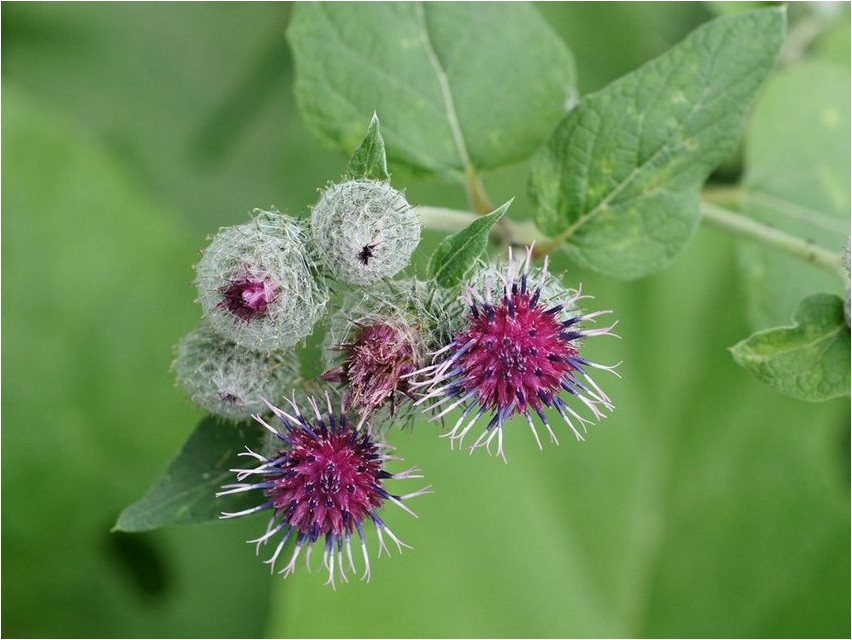
Felt burdock is one of the plants of the family called Asteraceae or Asteraceae; in Latin the name of this plant will be as follows: Arctium tomentosum Mill.
As for the name of the felt burdock family itself, in Latin it will be like this: Asteraceae Dumort.
Description of felt burdock
Felt burdock is a biennial herbaceous plant endowed with a long, thick and taproot. The stem of this plant is erect and grooved, in the upper part it will be branched, and its height will fluctuate between sixty and one hundred and eighty centimeters. The leaves of tomentose burdock will be ovate-heart-shaped and petiolate, and the upper leaves are ovate-oblong, and below they will be grayish-tomentose. The flowers of this plant are bisexual and tubular, they are colored in dark purple tones and are collected in spherical baskets, the diameter of which is about fifteen to twenty-five centimeters. Such spherical baskets will form corymbose inflorescences located at the top of the stem. The leaves of the wrapper are cobwebby, the inner leaves at the very top will be notched or truncated, they are pointed and colored in purple tones. The fruits of burdock are slightly wrinkled achenes, oblong, brown, ribbed and flattened; such achenes are also endowed with a tuft consisting of rather short, rough bristles.
Felt burdock blooms from July to August. Under natural conditions, this plant is found in the European part of Russia, Siberia, Ukraine, Kazakhstan, Belarus and Central Asia, and as an alien plant, felt burdock can be found in the Far East. To grow, this plant prefers rich soils, garbage areas, places along river banks, forest edges and alder forests.
Description of the medicinal properties of felt burdock
Felt burdock is endowed with very valuable healing properties. The presence of such valuable healing properties should be explained by the content in the roots of this plant of protein, inulin, tannins and fat-like substances, essential oil, sitosterol, sigmasterol, palmitic and stearic acid, resinous substances and an alkaloid, which will be endowed with antitumor activity. The leaves of burdock contain essential oil, tannins, mucus and ascorbic acid, and the seeds contain the glycoside arctiin. It is noteworthy that burdock has been known as a medicine since ancient times.
The roots of this plant are used as a diaphoretic and diuretic, and are also used for rheumatism and gout. Infusion and decoction of this plant are used to improve metabolism for chronic gastritis, edema, kidney stones and peptic ulcers, prostatitis, stomach cancer, pustular skin lesions, diabetes mellitus, boils, lichen, scab, seborrhea, ulcers, bruise, acne, seborrhea, itchy rashes and eczema.

Fresh crushed leaves or juice from them are recommended for use in the treatment of cuts, purulent wounds, burns, ulcers and abscesses. A decoction prepared from the seeds of this plant should be used for chronic constipation. A very popular remedy is burdock oil, which is used as an external remedy to improve hair growth and strengthen hair. Actually, this burdock oil is an infusion of burdock root in olive, almond or peach oil.