Double-needle currant
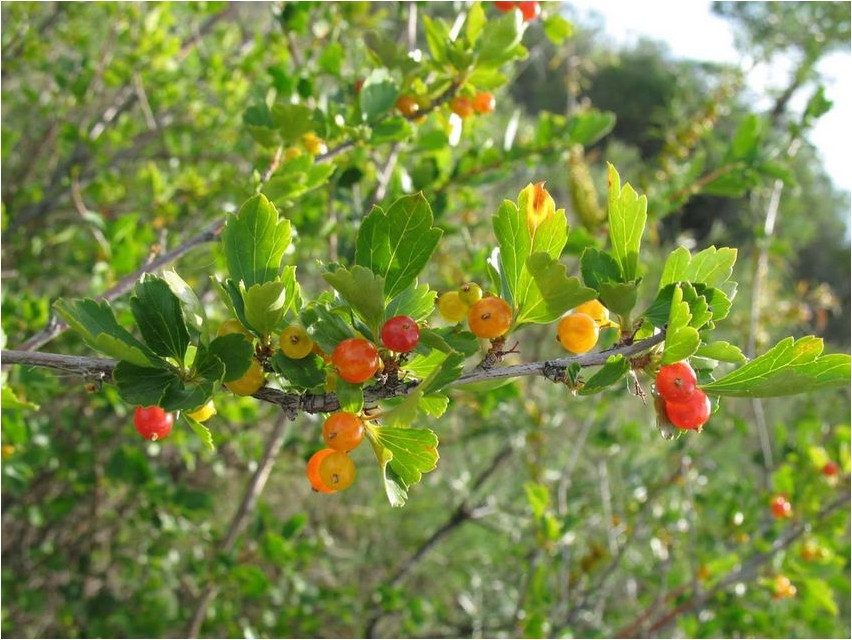
Double-needle currant is one of the plants of the family called Saxifragaceae; in Latin the name of this plant will be as follows: Ribes diacantha Pall.
As for the name of the double-needle currant family itself, in Latin it will be: Saxifragaceae Juss.
Description of double-needle currant
Double-needle currant is a shrub whose height reaches one and a half meters. The branches of this plant are quite numerous, they are collected in bunches, sometimes such branches can be drooping. The leaves of the double-needle currant reach a length of about one and a half to three centimeters; such leaves will be thin and dense, while on both sides they are bare. From above, such leaves are painted in dark green tones and will be shiny, but from below these leaves are lighter and whitish, they are endowed with veins and will be oblong-wedge-shaped in shape. In the upper part, the leaves of the double-needle currant can be either lobe-shaped or shallowly three-lobed, while the blades along the edge are equipped with sharp teeth that end in a point. The inflorescence of this plant will be bare, the berries are small in size and they are colored red, the diameter of such berries will reach about five to seven millimeters, they will be spherical in shape, and the berries are inedible.
The flowering of double-needle currant occurs from May to June, while fruiting will begin in August. Under natural conditions, this plant is found in the Daursky region of Eastern Siberia, as well as in the west of the Amur region and Primorye in the Far East. As for the general distribution, double-needle currant can be found in North Korea, Mongolia, China and Japan. For growth, double-needle currant prefers rocks, rocky slopes and screes, and the plant will grow in small thickets. It is noteworthy that needle currant is a very ornamental plant.
Description of the medicinal properties of double-needle currant
Double-needle currant is endowed with very valuable healing properties, and it is recommended to use the fruits, branches and leaves of this plant for medicinal purposes. The presence of such valuable healing properties should be explained by the content of cyanogenic compounds in the young leaves of this plant, while the fruits will contain vitamin C and carbohydrates.
A decoction made from the branches of the black currant is used for scrofula. This plant is quite widespread in Tibetan medicine. For tuberculosis of the lymph nodes, the fruits or leaves of the black currant should be used. A decoction made from the dried fruits of this plant is indicated for various gynecological conditions.

For tuberculous lymphadenitis, the following highly effective remedy based on this plant is recommended: to prepare this remedy, take ten grams of crushed dried black currant branches and add approximately two hundred milliliters of water. The resulting medicinal mixture should first be boiled for five to six minutes, then left to steep for approximately one hour, after which the mixture should be thoroughly strained. Take one tablespoon of this black currant-based remedy three times daily, regardless of meals. It’s worth noting that, when used correctly, this remedy based on blackcurrant will be quite effective.