Kuruba
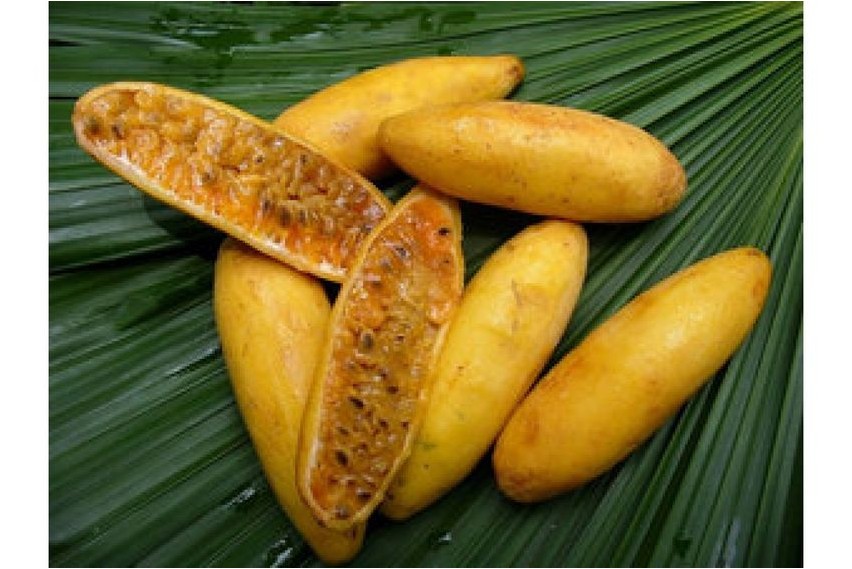
Kuruba (lat. Passiflora mollissima) is an exotic plant, which is often called passionflower or banana granadilla and the fruits of which have some resemblance to cucumbers.
Description
Kuruba is a vine that reaches a height of five to seven meters. Each stem of such a vine is densely covered with miniature yellowish fibers. The leaves of the plant are quite long — up to ten centimeters in length, and their width often reaches twelve centimeters. The edges of all the leaves have tiny, fancy teeth.
Kuruba blooms with amazingly beautiful and very large drooping soft pink flowers, the diameter of which can reach seven to eight centimeters. But these amazing flowers have no smell.
The length of kuruba fruits varies from five to twelve centimeters, and their width ranges from three to four centimeters. They weigh from fifty to one hundred and fifty grams. On the outside, this fruit looks like a cucumber (only its size is more impressive), but on the inside it is very similar to corn. Ripe bright yellow fruits with a slightly greenish tint (unripe fruits are always green) hide a juicy aromatic pulp of fiery orange shades, which has a sweet and juicy taste with pronounced sour notes. The pulp consists of a huge number of orangeish transparent grains, through which you can see small dark seeds that are similar to pomegranate seeds. By the way, kuruba boasts a very respectable water content!
Where does it grow
Argentina, Colombia, Uruguay and Bolivia — this is the distribution area of the delicious curuba. It grows especially well in cool areas and desert plateaus. Despite the fact that in general this crop is considered wild, in many regions they have learned to cultivate it — now Kuruba agricultural technology is widely practiced in India and New Zealand. And in California it is actively grown as an ornamental crop.
Application
Most often, kuruba is eaten fresh — this magnificent fruit perfectly helps quench thirst. Kids simply love fruit salads with fresh kuruba, and they also make excellent refreshing juice, original jam with a very unusual taste and wonderful jelly. In addition, kuruba is often added to ice cream and is actively used to make wine. As for the skin, it is not eaten.

Kuruba is not without healing properties — it is an excellent helper for ulcers, gastritis and stomach pain. These attractive fruits are rich in vitamin C and contain valuable substances such as phosphorus, iron, riboflavin, carbohydrates, niacin, calcium, proteins and minerals. Kuruba has an excellent calming effect, is great for coping with stress and even helps improve sleep.
Growing and care
Growing this plant is not at all difficult, since it is not at all capricious and can withstand even significant short-term drops in temperature (down to minus two degrees).
In the Colombian region, curuba fruits are harvested throughout the year, but in New Zealand, this crop begins to bear fruit only at the end of March, and fruit collection is possible only until the end of October.
Typically, fresh seeds will take two to three weeks to germinate (provided they are kept at room temperature), while old seeds will begin to germinate much later. Transplantation of seedlings begins when they reach three months of age, forming them on a strong two-meter trellis. This plant will develop best at temperatures from fifteen to twenty degrees and with sufficiently high humidity in both air and soil. And kuruba fruiting will begin only after the plant is two years old.





