Bobovnik
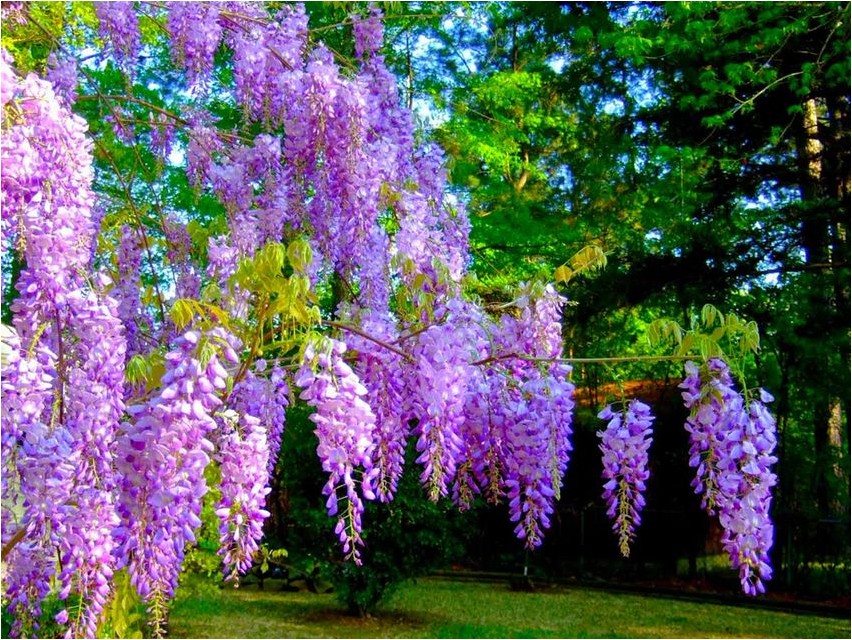
Bean (lat. Laburnum) is a deciduous shrub or tree of the Legume family. Other names are Golden Shower or Laburnum. Under natural conditions, bean grows in Southern Europe and Central Asia.
These days, the plant is widespread in the south and center of Europe. The bean plant was introduced into Russia at the beginning of the 19th century.
Characteristics of culture
Bobovnik is a plant characterized by spectacular flowering in the form of long flowing racemose inflorescences of golden yellow color, almost completely covering the bush. The leaves of the bean are light green, trifoliate, alternate, equipped with a petiole and stipules. The leaves are sessile. The buds are broadly ovoid, with 2-3 outer scales.
The flowers are fragrant, moth-type, yellow, collected in leafless, pendulous or erect racemes. The calyx is irregularly campanulate, bilabial, up to 5 mm long, has two teeth on the upper lip and three on the lower lip. The petals are free, 2-3 cm long, slightly longer than the boat and wings. The fruit is a single- or multi-seeded linear bean, flat, thick at the seams and slightly winged, opening late, located on a long stalk.
The bean tree blooms in May-June, the flowering period is 15-20 days. The most common species are: anagyroid bean (lat. Laburnum anagyroides) and alpine bean (lat. Laburnum alpinum). There are several decorative forms of anagyrofolia: weeping bean, oakleaf bean, golden bean (distinguished by the golden color of young leaves) and autumn bean (blooms again in autumn). There are relatively winter-hardy species, but in the conditions of central Russia they bloom irregularly. The plant is indifferent to smoke and gases, so it can be grown in city parks and alleys.

Growing conditions
Bobovnik prefers intensely lit areas with loose, well-drained, rich soils. Lime soils are not prohibited. Lowlands, swampy, acidic, saline and waterlogged soils are not suitable for growing beans.
Reproduction and planting
The bean plant is propagated by seeds, cuttings and layering. The seed method is simple and effective. The seeds are sown in late autumn under cover in the form of sawdust or peat. When sowing in spring, the seeds are subjected to preliminary stratification. In this case, seedlings appear 30-40 days after sowing. Young bean trees bloom in the third year.
Bean cuttings also do not pose any particular difficulties; summer cuttings do not require preliminary preparation and take root easily. When propagating by layering, the lower shoots are bent to the ground, pinned and covered with soil. The next year, the rooted shoots are separated from the mother plant and transplanted to a permanent place. Hybrid varieties are also propagated by grafting.
Care
Caring for beans is practically no different from caring for other ornamental deciduous shrubs. Due to the fact that plants have a superficial root system, weeding is carried out very carefully. Watering is required rare but plentiful, especially during prolonged drought. Fertilizing with nitrogen fertilizers is carried out in early spring, phosphorus-potassium fertilizers — in late autumn.
The bean plant also needs preventative pruning; old, dry, broken and frozen branches are removed from the plants. If the bean tree is used as a canopy, formative pruning is also performed. Young plants tolerate this procedure without problems, but adults react to it very painfully. Shrubs are covered for the winter, otherwise death cannot be avoided, this is more true in regions with cold climates.
Application
Bobovnik has become widespread in the landscape design of parks and gardens. It is planted in small groups and individually. It is not recommended to use the crop in linear plantings, since the plants lose their decorative appearance, the abundance of flowering and the splendor of the crown.
Looks extremely harmonious against the background of the lawn. Goes well with hawthorn, wisteria, heather, columbine, mock orange, rhododendron, mackerel and other coniferous and deciduous shrubs and dwarf trees.
Bean wood is distinguished by its unique texture, beautiful color and durability. Various musical instruments, bows, crossbows, souvenirs and sculptures are made from it. Some parts of the plant are used in folk medicine.