Citron
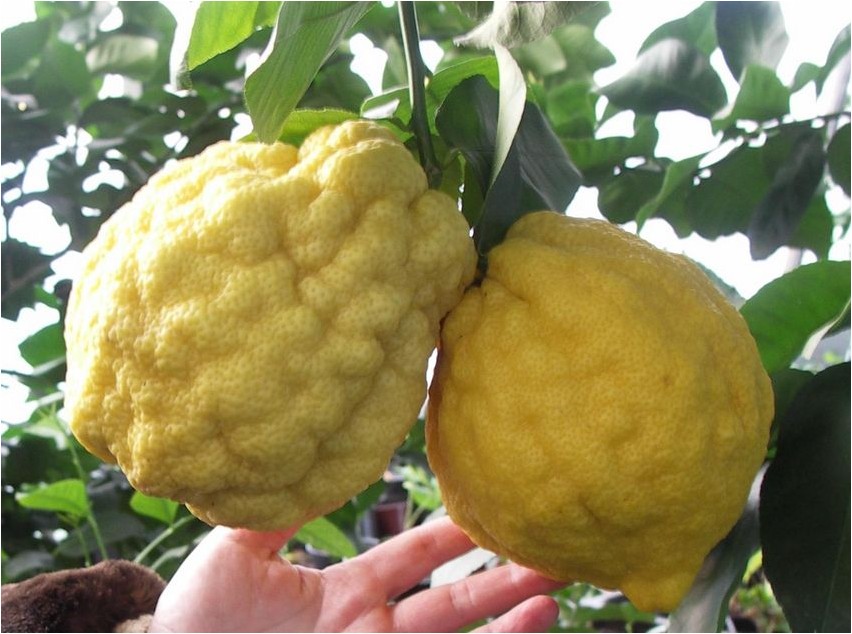
Citron (Latin: Citrus medica) is a perennial plant of the Rutaceae family.
History
Citron is one of the most ancient plants: the earliest mention of this plant appears in the Bible. Martial, Palladio, Virgil, and Theophrastus also wrote about it.
The origin of this unusual tree is shrouded in legend. Botanists have never been able to come to a consensus on how exactly the citron came to Europe. Some historians suggest that Alexander the Great brought it to the Mediterranean in the 3rd century BC. He may have acquired it from the banks of the Nile, India, or Mesopotamia.
Description
Citron is a compact shrub or small tree growing up to three meters in height. Its branches, three to five centimeters long, are equipped with single axillary spines. The dense, oblong-oval leaves of the citron have winged, rather short petioles and are distinguished by their slightly pointed shape. Typically, the upper leaves of growing shoots are purple in color, while on mature shoots they are dark green.
The relatively large flowers of the citron, either solitary or gathered in clusters, are white with a slight reddish tint. They can be either functionally male or bisexual.
The citron fruit is the largest of all citrus fruits: its diameter ranges from eight to twenty-eight centimeters, and its length varies from twelve to forty centimeters. All fruits are distinguished by their oblong shape and very thick skin (from two and a half to five centimeters). Their color is usually yellow, but orange fruits are sometimes found. Where it grows

In ancient times, this crop was widely cultivated in the Mediterranean, Western Asia, and Western India. Long before the Common Era, the citron was the first to reach Europe.
Currently, citron is grown in many countries, albeit in relatively small areas. These trees and their fruits are not widely used in the food industry and are susceptible to frost damage as soon as the thermometer drops to minus three or minus four degrees Celsius.
Use
The fresh fruit pulp is not eaten, as it is either low-juicy and sour, or sweet and sour with a distinct bitterness. However, citron fruits are widely used in the confectionery industry, where they are used to make all kinds of fillings and delicious jams.
The incredibly aromatic peel of the fruit yields a valuable essential oil, which is widely used not only for making candied fruits and jams, but also for flavoring culinary and confectionary products, as well as a wide variety of beverages.
The rare aromatic properties of citrons also allow them to be used in the perfume industry. The Calabrians consider these unusual fruits a panacea for all ailments.
Cultivation
Citrons have extremely low yields, and no amount of gardening can increase their yield. The harvest is usually in November.
This crop cannot tolerate low temperatures; even in Mediterranean countries, citrons are covered with reed mats. This measure is especially necessary for citrons growing near the sea or along riverbanks.
Diseases and Pests
In cases of excess moisture, as well as in cases of moisture deficiency, citron leaves can become affected by various types of leaf spotting and begin to fall off very quickly. The main pests of citrons are mealybugs, the ruthless red citrus mite, and some species of scale insects. Incidentally, scale insect excretions are often infested with sooty mold.
Citron
https://www. youtube. com/watch? v=jSioiinN0-U
Citron citron





