Mistletoe painted
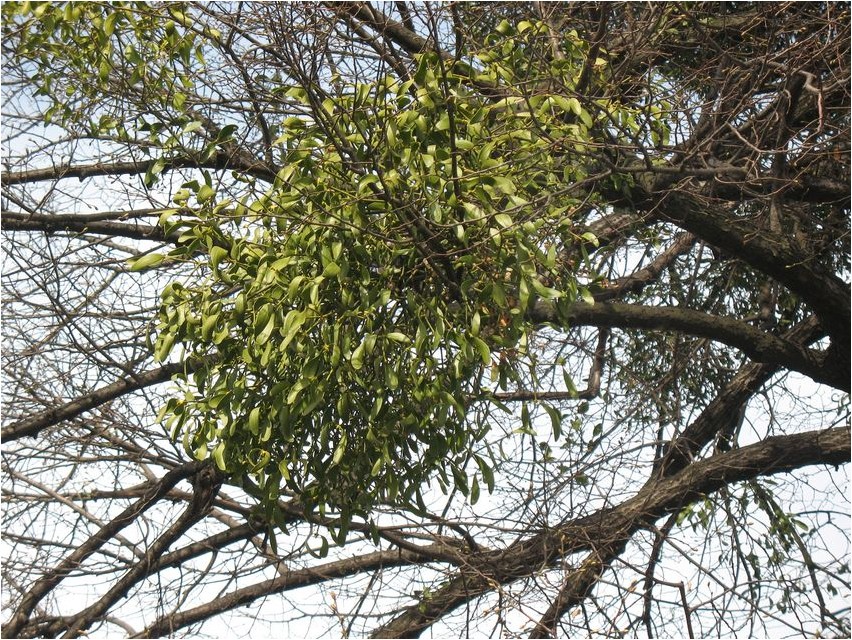
Colored mistletoe is one of the plants of the family called Limaceae; in Latin the name of this plant will be as follows: Viscum coloratum L.
As for the name of the colored mistletoe family itself, in Latin it will be: Loranthaceae Juss.
Description of painted mistletoe
Painted mistletoe is a green pest, and the branching roots of this plant will penetrate under the bark of trees. The branches of this plant will be opposite and woody. The entire plant is highly branched, and its diameter will be about one hundred to one hundred and twenty centimeters. Painted mistletoe leaves are leathery, entire and thick, and will be dark green in summer and yellow-green in winter. The fruit of this plant is a false sticky and juicy berry, the diameter of which is nine to ten millimeters; most often such a fruit will be colored in red-orange tones, and sometimes it can be yellow in color.
Under natural conditions, this plant is found in the southern regions of the Khabarovsk Territory and in the Primorsky Territory. As for the general distribution, this plant can be found on the Korean Peninsula and in China. Mistletoe will parasitize on a variety of deciduous trees: poplar, linden, birch, maple, pear, apple and aspen.
Description of the medicinal properties of colored mistletoe
Painted mistletoe is endowed with very valuable healing properties, and it is recommended to use the fruits, stems and leaves of this plant for medicinal purposes. The presence of such valuable healing properties is recommended to be explained by the content of the branches and leaves of colored mistletoe with beta-amyrin acetate, lupenol, betulin, lupeol acetate, alkaloids, phenols and their derivative substance syringin, viscumamide polypeptide, ceryl alcohol, flavonoids flavoyadorinin B and flavoyadorinin A. are present in the leaves terpenoids, cyclitol lysoinositol, lignan, flavonoids and viscumamide polypeptide.
Mistletoe has very effective anticonvulsant and hemostatic properties that regulate the menstrual cycle. An infusion made from the stems of this plant is recommended for neuroses. It is noteworthy that in the Amur region, a decoction made from mistletoe leaves is used for rheumatism, diarrhea, and hypertension, and is also used as an anti-inflammatory. It is worth noting that experimentally confirmed that a tincture based on this plant is non-toxic.

A decoction made from the leafy branches of this plant is used for severe stomach pain. An ointment made from mistletoe berries is recommended for topical use for breast cancer.
In Chinese medicine, a tincture of this plant is considered effective. This tincture is used for poliovirus infection due to its antiviral activity. Furthermore, preparations based on this plant exhibit antiviral activity against many viruses that cause nonbacterial meningitis.
Furthermore, it has been proven that preparations based on this plant, when parasitized on mulberry, inhibit the growth of staphylococcus and typhoid bacilli. In China, this plant is also used as a sedative, tonic, and analgesic. Preparations based on mistletoe are used for general weakness, neuralgia, rheumatic joint pain, post-severe illnesses, lower back pain, and hypertension.





