Corn
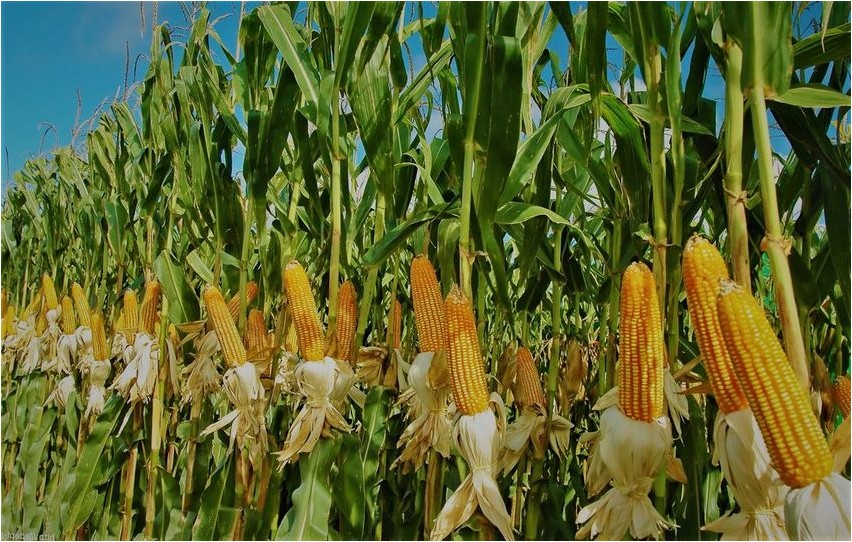
Corn (lat. Zea) is a popular vegetable crop; annual plant of the Poaceae family.
Characteristics of culture
Corn is a herbaceous plant with a straight erect stem 50-300 cm high, reaching 5-7 cm in diameter. The root system is fibrous with a large number of adventitious roots penetrating to a depth of 100-150 cm. Aerial support roots are formed on the lower nodes of the stem, which protect the plant from falling and supply it with nutrients and water.
The leaves are large, broadly bladed or linear-lanceolate, with a short tongue, 60-80 cm long, pubescent on the outside, bare on the bottom, arranged alternately. Each stem develops from 1 to 6 ears, surrounded by leaf-like involucres, with a tuft of long pistillate styles extending outward.
Depending on the variety, 400-1000 grains of elongated, elongated, cubic or round shape are formed on one cob, tightly pressed to each other, arranged in 8-16 rows. The grains are white or yellow in color; there are varieties with red, pink, blue, purple and even black grains.
The growing season for corn is about 90-150 days. Under optimal growing conditions, seedlings appear within 10-12 days. Currently, there are eight botanical groups of corn: popping, flint, dent, sugar, starchy, waxy, hulled and starchy-sugar.

Growing conditions
Corn is a heat-loving plant; it prefers well-lit areas, protected from cold and piercing winds. The optimal temperature for normal development and growth is 20-24C. Soils for the crop are preferably light, loamy, sandy loam or podzolic with a neutral pH. Corn has a negative attitude towards compacted, heavy and saline soils.
The plant does not make any special demands on its predecessors, for this reason it can be planted in areas where sugar and fodder beet varieties, leguminous crops, buckwheat, potatoes, cereals, etc. were previously grown. It is not recommended to sow corn after millet.
Sowing
Corn is sown in the spring: early varieties on May 1-10, late varieties on May 20-30. The site is prepared in the fall, the soil is plowed to a depth of 27-30 cm, humus, superphosphate, wood ash and potassium salt are added. In the spring, they are re-plowed and fertilized with nitrogen fertilizers. The depth of seed placement in arid areas is 10-11 cm, in all other areas — 4-5 cm. The distance between plants should be about 25-35 cm, and between rows — 60-70 cm. Important: plants located alone are poorly pollinated, and half-empty ears are formed on them.
Care
Corn is quite demanding to care for. During the first three weeks, plants develop very slowly, so they need systematic weeding and loosening of rows. Corn also responds positively to fertilizing; the first fertilizing is carried out in the second ten days of June, the second — July 1-10. In wet weather, plants form side shoots that must be removed from time to time. During the flowering period, especially in the absence of wind, it is recommended to carry out artificial pollination by shaking the stems with flowering plumes.
Pest and disease control
Quite often, corn is affected by various fungal and viral diseases. One of the most dangerous diseases is loose smut; it can mercilessly ruin about 40-45% of the crop. A large number of black spores appear on the panicles of corn, which subsequently infect the entire plant. Unfortunately, effective drugs against black smut have not yet been invented, so the only method of combating it is considered to be the removal of corn by the roots.
An equally dangerous crop disease is bladder smut. Bubble-like swellings 10-15 cm in size form on the plants. The disease leads to a decrease in the quantity and quality of the crop, and sometimes to death. Bladder smut is spread by precipitation, wind, insects and birds. When the first signs are detected, the plants are removed and burned.
A common pest of corn is the corn stem borer. Its caterpillars feed on panicle flowers, pollen grains and other plant parts. It is quite difficult to fight the pest, since it leads a hidden lifestyle. Experienced gardeners advise carrying out phytosanitary measures or releasing the Trichogramma egg eater.