Gunner
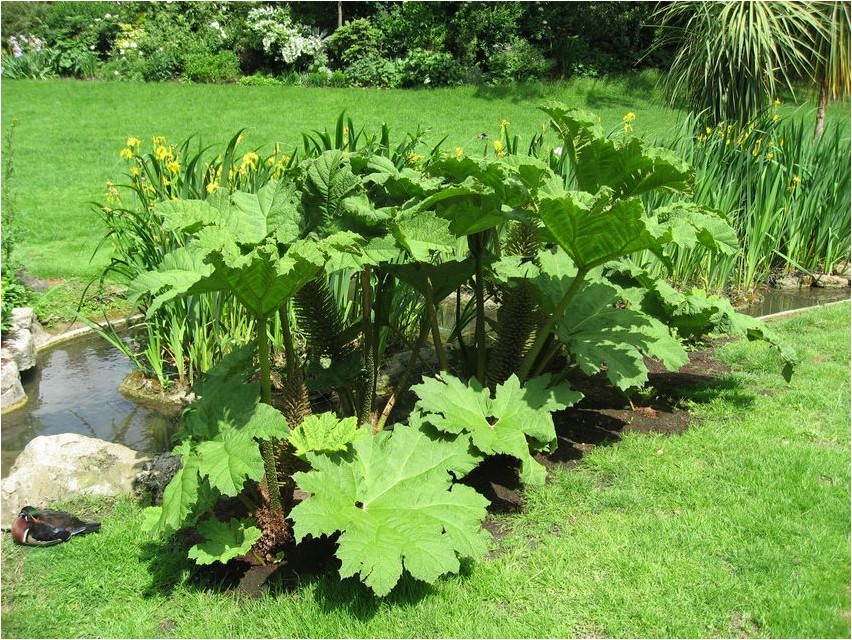
Gunnera (lat. Gunnera) is a herbaceous plant belonging to the Gunneraceae family. Gunner received such an interesting name in honor of Ernst Gunner, a famous Norwegian botanist.
Description
Gunnera is a fairly large rhizomatous perennial plant, endowed with lodging stems and rather rough leaves sitting on long petioles. All leaves are round in shape and boast jagged leaf blades. Under good conditions, the height of this plant can reach five meters, and the diameter of its leaves is one and a half meters! By the way, gunnera is somewhat reminiscent of rhubarb in appearance.
Gunnera inflorescences look like compact, but at the same time quite thick panicles, painted in greenish tones that are pleasant to the eye and consisting of completely inexpressive small flowers. The flowering process of this plant starts in July and ends in August.
In total, the genus Gunnera includes about fifty species.
Where does it grow
Gunnera is a plant native to southern Brazil: there it grows mainly in rain forests, and at a fairly high altitude. Quite often, gunnera can be found in New Zealand or Tasmania, sunny Madagascar, Southeast and South Africa, as well as America — Central and South.
Usage
In culture, gunnera has found its application as an ornamental plant quite widely used for landscape design. This plant will look especially great near large or medium-sized bodies of water. And Gunnera Magellanica is great for planting near small ponds or in winter gardens, and for growing at home. Moreover, it is an excellent ground cover plant!

In addition, the petioles of the leaves of some varieties of Gunnera are actively used for preparing a wide variety of vegetable dishes, and decoctions from the rhizomes of Gunnera tona, which grows mainly in Africa, are used as a sedative for children.
Most popular varieties
Gunnera Magellanica. This is the smallest, almost dwarf, plant of the entire family. The diameter of its leaves almost never exceeds five centimeters, and the plant itself usually forms luxurious mats up to ten centimeters high, no more.
Gunnera dyeing. Under proper growing conditions, the diameter of its leaves can reach up to one meter.
Gunnera sleeve (vaginal). Its leaves often reach a diameter of as much as three meters! True, in the conditions of the middle zone, the diameter of its leaves rarely exceeds fifty to sixty centimeters. From a distance, this variety of gunnera very much resembles a well-fed large hogweed. Both the undersides of its leaves and petioles with stems are densely strewn with rough spines.
Growing and care
Gunnera will feel best on marshy banks, in the sun (warm and generously lit areas are the most ideal place for planting this plant!) or in partial shade. And in order for it to delight with its high decorativeness throughout the season, it must be planted on the most fertile soils. One should not discount the fact that gunnera is a very moisture-loving plant.
Gunnera cannot boast of good winter hardiness, however, in regions characterized by a fairly cool climate, it can sometimes still survive the winter with proper insulation with twigs or leaves. The most important thing is that the frosts are mild and short-lived. In the middle zone of the rhizome, gunners are usually placed for the winter in boxes with well-moistened sand, after which these boxes are transferred to the cellar for storage. As for the propagation of this plant, it usually occurs by dividing the rhizomes.