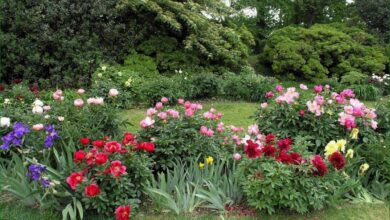
Krasodnev
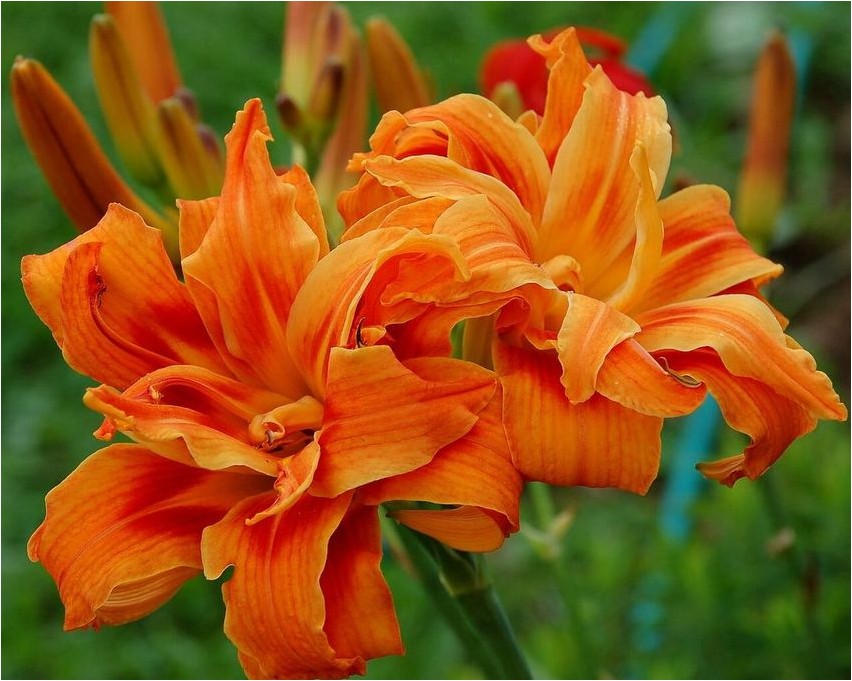
Hemerocallis (lat. Hemerocallis) is a beautifully flowering perennial from the large Liliaceae family. Its second name is daylily.
Description
Krasodnev is a rhizomatous herbaceous perennial, endowed with the ability to form fairly large bushes up to one meter high.
The leaves of Krasnodnev are curved, xiphoid and basal. And the large flowers of this plant reach twelve centimeters in length, are collected in elegant paniculate inflorescences and sit on very high peduncles. All of these flowers boast a funnel-shaped shape and are yellow, reddish-brown, pink or orange in color. In sunny weather, the flowers are invariably wide open, but the lifespan of these beauties is no more than one day. As a rule, one to three flowers open at a time, but in general, the total duration of flowering of the bushes is on average twenty-five days, and sometimes more. And the shape of the flowers of the Red Day can be as varied as desired: in the form of spiders (with long narrow petals), flat, bent, round, multi-petaled, terry, curved, lace, corrugated, triangular, tubular, star-shaped, etc. As for the flowering time, depending on the variety and species, it usually covers the period from May to September.
In total, the genus Krasodnev has about twenty species.
Where does it grow
Krasodnev can be especially often seen in the meadows located in East Asia. However, it is quite widespread in Europe.
Usage
Krasodnev is quite actively used in decorative floriculture — it can often be found in gardens and parks.

Growing and care
In general, it is quite undemanding both in terms of care and growing conditions — although it is light-loving, it also tolerates partial shade very well, however, for abundant and massive flowering, it is still better to plant it in sunny places (this is especially true for hybrid varieties). As for soils, nutritious and well-drained substrates enriched with organic fertilizers will be most preferable for growing krasnodnev.
You should water redwoods rarely, but always abundantly, watering directly under the root. And after watering, the soil must be mulched with dry peat. The plant is also fed twice during the season — it is best to use complete mineral fertilizers enriched with various microelements for these purposes. The first feeding is usually carried out in the spring, at the stage of leaf growth, and the second feeding is carried out a month after the peak of flowering, at the moment the flower buds of the next year begin to form on it. As a rule, fertilizers are incorporated into the soil before watering.
Immediately after flowering, you will need to cut off the flower shoots from the plant, and the flowers themselves after flowering are also either cut off or broken off. And before winter you will also need to cut off the leaves, leaving only young leaves on the plant (winter leaves).
Krasodnev is able to grow in the same area without replanting for up to twelve to fifteen years. However, after some time, both the soil and the plants themselves begin to gradually deplete, the flowers become noticeably smaller, and this is also not reflected in the best way on the foliage. In addition, plants that are too old turn out to be quite difficult and very problematic to dig up and divide. Therefore, in order to avoid all of the above troubles, division and replanting is still recommended every five years.
And propagation of the red day is usually carried out by dividing the bushes, which is carried out at the end of April or at the beginning of May, at the time of spring leaf growth. If you grow this beauty from seeds, then its varietal characteristics are usually not preserved in this case.
Wedding without flowers simply unthinkable. All guests, parents and witnesses congratulate the newlyweds, accompanying their warm words with gifts and bouquets. There are many signs and traditions associated with this accessory; the harmony of the image is also important.