Cardaria granulosa
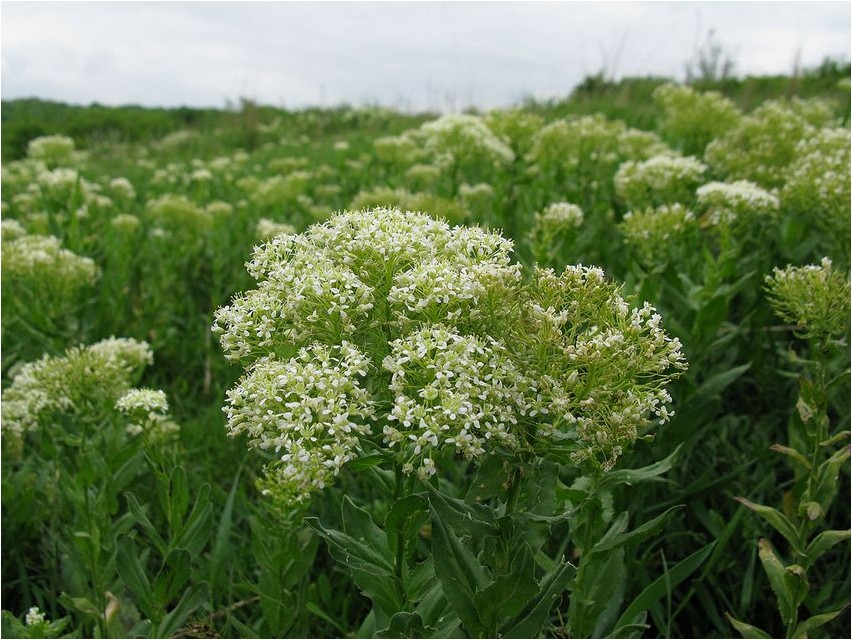
Cardaria draba is one of the plants of the family called cruciferous or cabbage; in Latin the name of this plant will be as follows: Cardaria draba (L.) Desv.
As for the Latin name of the cardaria family itself, in Latin it will be like this: Brassicaceae Burnett.
Description of cardaria krupkovidae
Cardaria granulosa is a perennial herbaceous short-fluffy plant, the height of which will be about twenty to fifty centimeters. The stems of this plant are straight, and at the top they will be corymbose-branched. It is noteworthy that the basal leaves taper into a petiole, for the most part they will be either notched or almost lyre-shaped, and sometimes such leaves can also be pinnate. The middle and upper leaves of Cardaria croupoid are lanceolate. The flowers of this plant are in corymbs and they have a very bright aroma. The sepals of cardaria croupoid are naked, their length is one and a half to two millimeters, such sepals are also white-edged. The petals of this plant are painted white, their length is two and a half to four millimeters, and the pods are bare, their length is three to four and a half millimeters. Cardaria seeds can be either ellipsoidal or oval, they are slightly flattened and not bordered, and they will be colored in rather dark tones.
Flowering of caradria krupkovidna occurs in the period from May to June. Under natural conditions, this plant is found in Central Asia, Ukraine, Moldova, Belarus, the Caucasus, the European part of Russia, with the exception of only the north, as well as the Verkhnetobolsk and Irtysh regions of Western Siberia. As for its general distribution, this plant can be seen in Iran, Syria, Palestine, the Balkans and the Mediterranean. For growth, the plant prefers forest clearings, ravines, meadows, forest edges, steppe and steppe slopes, places near housing and along roads, as well as pastures.
Description of the medicinal properties of cardaria croupoid
Cardaria granulosa is endowed with very valuable healing properties, and it is recommended to use the juice of the herb, fruits and grass of this plant for medicinal purposes. The term grass includes flowers, stems and leaves. The presence of such valuable healing properties is explained by the plant’s content of vitamins C and E, carotene, coumarins, alkaloids, flavonoids, thioglycosides and sulforaphane isothiocyanate. Cardaria fruits contain fatty oil and isothiocyanate.
As for traditional medicine, an infusion of the herb of this plant has become quite widespread, which is not only used as a very valuable antiscorbutic agent, but is also used internally for a variety of skin diseases.

The juice of the herb Cardaria granulosa is recommended to be used for hardening of the uterus, and also as an antifungal and choleretic agent. The tops of the stems along with the fruits of this plant should be used in the form of compresses for various benign tumors. A decoction of the fruits of this plant is taken for flatulence and fever, and also to improve the functioning of the stomach. It is noteworthy that the fruits of Cardaria coarse are used as a spice as a substitute for pepper.
It should be remembered that this plant is poisonous, for this reason it should be used with extreme caution. The following remedy should be used as an antiscorbutic and choleretic agent: to prepare it, take one tablespoon of crushed herbs per glass of boiling water. This mixture is infused for two hours and then filtered. Take this remedy three times a day, one to two tablespoons.