Comfrey hard
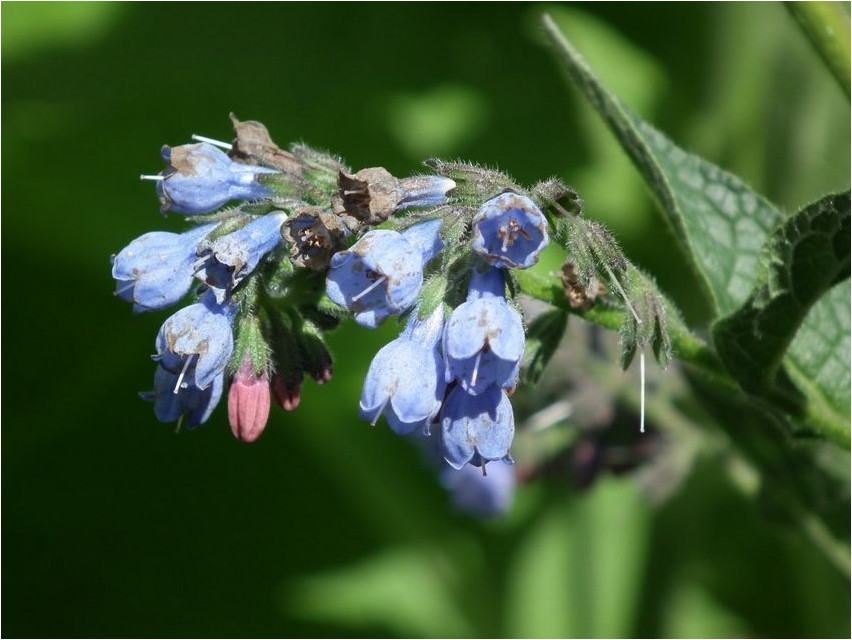
Comfrey, hard or rough, is one of the plants of the family called borage; in Latin the name of this plant will be as follows: Symphitum asperum Lepcch.
As for the name of the hard comfrey family itself, in Latin it will be: Boraginaceae Juss.
Description of hard comfrey
Comfrey, hard or rough, is a perennial herbaceous and strongly branched plant, endowed with wingless stems. Such stems will be covered with tenacious bristles that will face backwards. The lower leaves of this plant are petiolate while the upper leaves will be sessile. The leaf blade can be either lanceolate or oblong-ovate. Such a leaf will be endowed with a wedge-shaped or rounded base, and its top will be quite long and pointed. The calyx of hard comfrey turns out to be four to five times shorter than the corolla; it will be endowed with lanceolate obtuse lobes. The length of the corolla of this plant will be about fifteen millimeters, at first such a corolla will be painted in pink or light purple tones, then it becomes purple or blue, and the tube will be longer than the calyx. The fruits of hard comfrey are wrinkled nuts, painted black.
Rigid comfrey blooms in the summer. For growth, this plant prefers the banks of streams and rivers, forest edges and the mountains of the Caucasus, and is also found as an alien plant in garbage areas and wastelands throughout Ukraine and the European part of Russia.
Description of the medicinal properties of hard comfrey
Hard comfrey is endowed with very valuable healing properties, and it is recommended to use the roots of this plant for medicinal purposes. The presence of such valuable healing properties is recommended to be explained by the content of mucus, gum, inulin, alkaloids, choline, resin, glycosides, essential oil, asparagine and gallic acid, as well as tannins and starches in the roots of this plant. It should be noted that this plant is poisonous and for this reason it is recommended to exercise extreme caution when handling this plant.
Preparations based on hard comfrey are recommended for use as a hemostatic agent for internal bleeding, as well as an astringent for digestive disorders, and also as an expectorant for various pulmonary diseases.

A decoction and fresh root juice from this plant are recommended for treating nosebleeds, and poultices are used for bruises accompanied by hemorrhage into the subcutaneous tissue, as well as for carbuncles, boils, and long-term non-healing purulent wounds and ulcers. Among the particularly valuable healing properties of this plant is its ability to accelerate the regeneration of damaged tissue, especially bones.
A decoction based on comfrey is also indicated for gout and rheumatoid joint lesions. It is noteworthy that the roots of this plant also possess highly effective antitumor activity.
For baths, compresses, poultices, and washes for joint dislocations, bone fractures, periosteal damage, and osteomyelitis, it is recommended to use one part crushed roots to five parts vodka. The resulting mixture is infused for a week, and then taken twenty drops five times daily with one-third of a glass of water. When used correctly and following all the preparation guidelines, this remedy is highly effective and produces relatively quick positive results.