Comber
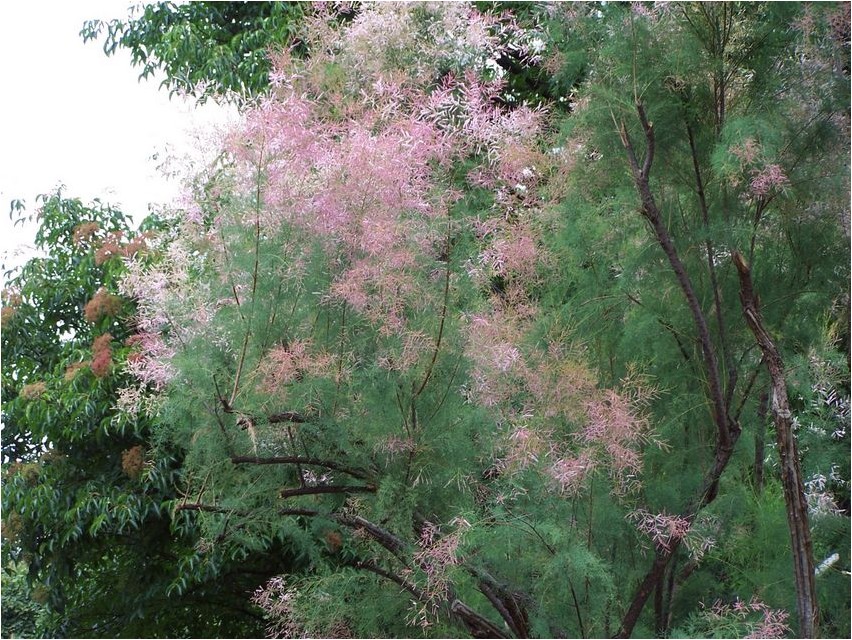
Combweed (lat. Tamarix) is a light-loving, winter-hardy woody plant from the Tamarix family. Its other name is tamarix.
Description
The comb tree is a low tree or shrub characterized by very spreading crowns. Moreover, these plants can be either evergreen or deciduous. As a rule, their height is about one to two meters, but sometimes it can reach three, and sometimes even twelve meters! As for the diameter of the trunks, it often reaches half a meter.
Many twig-like thin shoots of this plant are generously dotted with tiny bluish-greenish scale-like leaves. With the onset of autumn, the comb tree turns yellow, and not individual leaves, but small twigs begin to fall off! And the miniature purple, pink or white flowers of the comb form luxurious racemose inflorescences.
Living seeds in the vast majority of comb beetle species are usually colored light brown, and when they lose their germination, they gradually darken.
The name of the genus originates from the name of the Tamariz River located in the Pyrenees (now this river is called Timbra). In total, science knows more than sixty species of comb.
Where does it grow
The comb grows over very wide areas, from Southern Europe to India. Most often it can be seen growing in steppes, semi-deserts or deserts. And in the Russian expanses in nature, under natural conditions, you can meet only five species of comb.

Usage
In the southern regions, the comb is very often and quite actively used for landscaping — it is one of the best species both for decoration and for successfully solving such an equally important task as fixing loose sand. However, in central Russia this beauty is also found quite often: it creates incomparable constantly flowering thickets, in addition, it makes excellent hedges, although in this case it will require appropriate planting and, of course, regular haircuts. And small branches of the comb, as well as its inflorescences, are excellent for cutting.
Of particular interest is the wood of the comb — yellowish-gray or yellowish-white, ring-vascular, without division into sapwood and heartwood, with clearly visible growth rings, very dense and with amazingly beautiful patterns. However, due to the fact that truly large trees are extremely rare, such wood is used mainly for creating small crafts, and is also used for carving and turning.
The comber is also considered a good pergonos. Its young branches are eaten by cattle with great pleasure, and with the onset of autumn they can boast of quite strong laxative properties.
Growing and care
The comb plant is a heat-loving and very light-loving plant, however, some of its varieties can also boast of very good winter hardiness. This beauty will feel best on light and nutritious soils, although in general it is very undemanding when it comes to soils. And the comb is also very salt-resistant!
The comb tolerates transplants and haircuts very well, so you can safely perform these manipulations with it. As for wintering, there is no need to cover it for the winter — with the onset of spring, the frozen shoots of the plant are simply cut out.
And the comb plant is propagated both by shoots and cuttings (green cuttings are especially well suited for these purposes). By the way, in winter, branches can be rooted in water right on the windowsill!