Allium moly
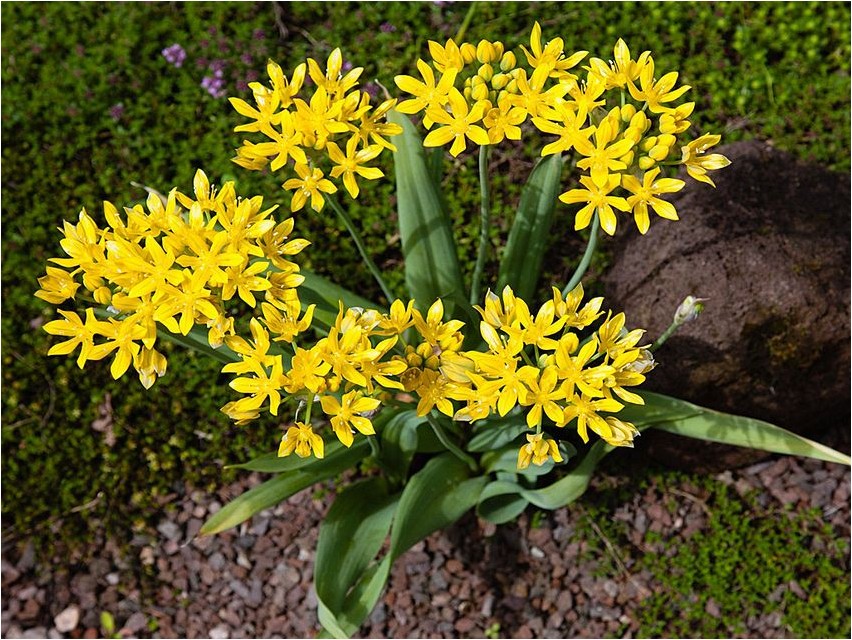
Allium moly (Latin: Allium moly) is a member of the onion family, known for its exceptional ornamental qualities. The plant is known as “golden garlic.”
It is found in the wild in many European countries. In Russia, it is cultivated as an ornamental crop.
Crop Characteristics
Allium moly is a perennial herb with an edible, spherical bulb, reaching 1. 5-2. 5 cm in diameter. The stems are straight, cylindrical, and up to 30 cm tall. The leaves are green with a bluish bloom, lanceolate, flat, and wide, drooping toward the tip. The flowers are large, yellow, and star-shaped, gathered in flat or hemispherical umbel-shaped inflorescences, ranging in size from 4 to 7 cm. Flowering occurs in late May to early June. Allium moly has a distinct garlicky scent. In one location, the crop can grow and develop normally for up to 10-15 years.
Growing Intricacies
Moly onion is an undemanding plant, but blooms best in sunny or semi-shaded areas. In dense shade, the bulbs rot and, consequently, do not form dense foliage and captivating inflorescences. Fertile, light, permeable, well-drained, moderately moist soil with a slightly acidic pH is preferred for growing the crop.
Moly onion is most often propagated by bulblets, offsets, and divisions. The first method is less labor-intensive and effective than the others. Propagation by offsets also presents no particular problems; however, their planting material is collected 2-3 years after planting the mother plant. Seed propagation is difficult, as the seedlings are weak and very small, making them very difficult to handle. Moreover, specimens grown from seed only bloom in the third or fourth year.
Planting and dividing the bushes is recommended in early spring or fall. In the latter case, a month before the onset of persistent cold weather. All operations are carried out in cloudy weather. The planting pattern for Moli onions is 10 x 10 cm or 15 x 15 cm, depending largely on the size of the bulbs. Avoid planting onions too closely, as the plants form fairly large clumps as they grow and will not tolerate dense growth.

Caring for Moli onions involves regular watering. It is not recommended to allow stagnation of water and drying out, as this will have a detrimental effect on the overall appearance. The plant is replanted once every 4-5 years, this is necessary in order to avoid thickening. Replanting is done when most of the plant leaves have withered. The inflorescences are removed immediately after flowering. In regions with cold winters, with the onset of persistent cold weather, plantings are mulched with natural material. In the southern regions there is no need for mulching.
Application
Moli onions are used for food, medicinal and decorative purposes. The plants are spectacular and look great in group plantings along with flowering crops. They are often used to create independent compositions, because bright yellow inflorescences can add zest to any garden corner. Moli onions look great in small dotted clumps along the border of the border; they are also suitable for decorating an alpine hill, rock garden and other rocky gardens. Moli onions will fit especially harmoniously into compositions made up of plants with blue and blue inflorescences.