Aspen
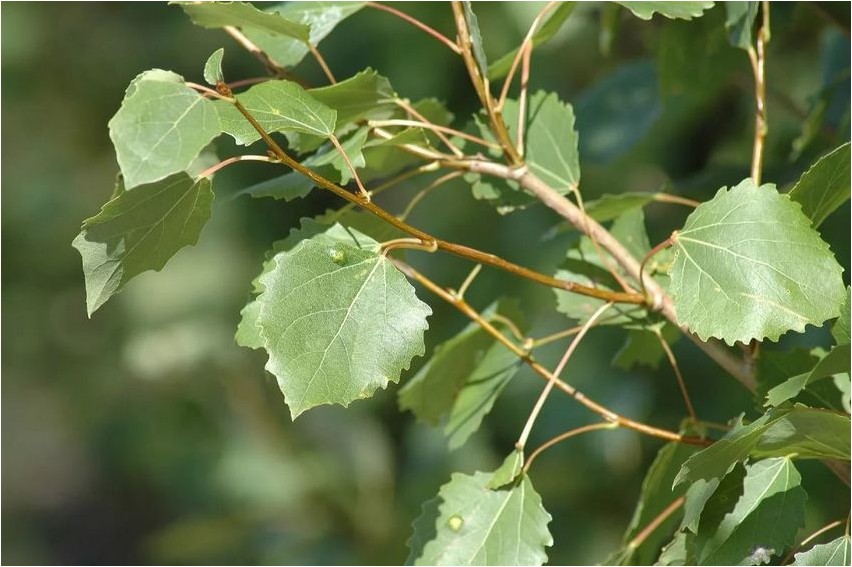
Aspen is one of the plants of the family called willow; in Latin the name of this plant will be as follows: Populus tremula L.
As for the name of the willow family itself, in Latin it will be: Salicaceae Mirb.
Description of aspen
Aspen is also known by the following popular names: gentian and whisperer tree. Aspen is a fairly large tree, the height of which can reach twenty-five meters, and its diameter in circumference will be equal to five meters. The bark of this plant is smooth and light, it is colored in greenish-gray tones, while the young branches will not be pubescent. The leaves of aspen shoots are deltoid and large, with finely toothed edges. The length of the earrings will be about four to fifteen centimeters, and the thickness will be approximately two centimeters; such earrings will be very shaggy. The ovaries of this plant are colored in light green tones, they are conical and endowed with two purple stigmas.
Aspen blooms during the period before the leaves bloom, starting in March and ending in May. Under natural conditions, this plant is found in Ukraine, many regions of Russia, Central Asia, the North Caucasus and Belarus. For growth, aspen prefers clearings, fires, birch forests, forests and places among bushes.
Description of the medicinal properties of aspen
Aspen is endowed with quite valuable healing properties, and it is recommended to use leaves, buds and bark of young branches for medicinal purposes. Buds and bark should be harvested in the spring, while leaves are harvested from May to June.
The presence of such valuable healing properties should be explained by the content of bitterness, glycosides, essential oil, tannins and malic acid in the buds and leaves of this plant. Aspen bark, in turn, will contain tannins, aromatic acids, phenol glycosides, fructose, glucose, sucrose and higher fatty acids.

Preparations based on this plant are endowed with very effective analgesic, antiseptic, anti-inflammatory and wound-healing effects.
As for traditional medicine, here this plant is quite widespread. A decoction prepared from the buds of this plant is recommended for use for colitis, diarrhea, dysentery, enterocolitis, myositis and fever. An alcohol tincture based on the inner part of the bark of young branches with leaves should be used for hemorrhoids, rheumatism, stomach pain, acute and chronic inflammation of the bladder. This tincture is made in a ratio of one to ten and take ten to fifteen drops per glass of water. It is worth noting that in order to ensure the greatest degree of effectiveness when taking such a remedy based on this plant, it is recommended not only to strictly follow all the rules for taking such a remedy, but also to follow all the rules for its preparation.
In addition, it is recommended to use young leaves of this plant, previously scalded with boiling water, as a poultice. Such poultices are used for gouty, rheumatic and hemorrhoidal pain. Dried and powdered buds of this plant should be used as an anti-inflammatory agent for hemorrhoids, chronic ulcers and burns. These raw materials should first be mixed with sunflower oil or butter.
In addition, an infusion based on the buds of this plant is a very effective remedy for cystitis and hemorrhoids. This remedy should be taken three times a day before meals.


