Amphibian Zherushnik
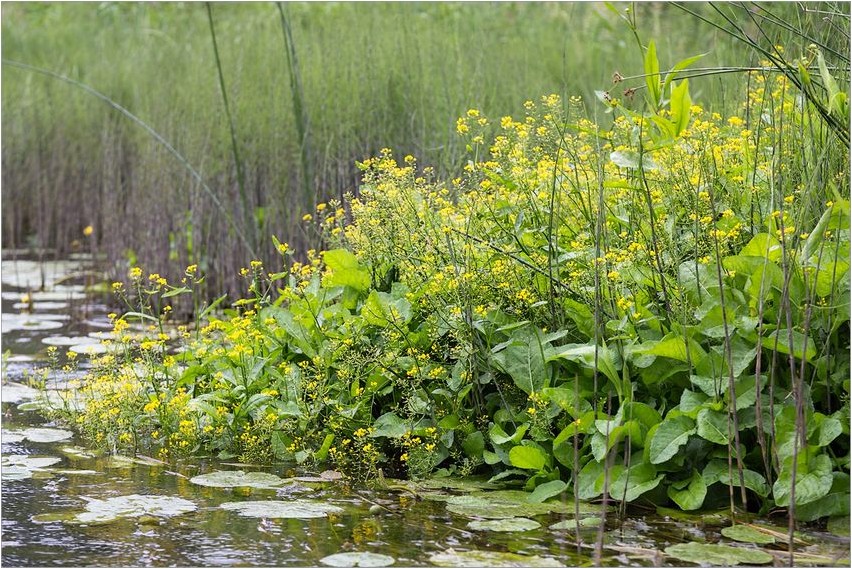
The amphibian fireweed is one of the plants of the family called cruciferous; in Latin the name of this plant will be as follows: Rorippa amphibia (L.) Bess.
As for the name of the amphibian zherushnik family itself, in Latin it will be like this: Brassicaceae Burnett.
Description of the amphibian zherushnik
The amphibian fireweed is a perennial aquatic or coastal herbaceous plant, the height of which will be about thirty to one hundred centimeters. The plant is endowed with a rooting, ascending, hollow stem. The lower leaves in water will be pectine-pinnately dissected, but on land they are entire and coarsely toothed. The upper leaves of this plant are oblong and entire. The petals of the amphibian zherushnik flowers are painted in bright yellow tones; they will be longer than the sepals. The fruits of this plant are spherical or oval pods, which are located on thin, long and almost horizontally deflected legs.
It should be noted that this plant is particularly resistant to frost and can tolerate cold temperatures down to minus twenty-three degrees. It is noteworthy that small seeds of this plant can fall into the silt, thereby sticking to the wings and legs of waterfowl: such birds will carry the seeds over quite significant distances into the following bodies of water. Actually, at home this plant can be kept even in an ordinary aquarium.
The flowering of the amphibian zherushnik occurs in the summer. Under natural conditions, this plant is found in the European part of the Arctic, in the European part of Russia, in Western and Eastern Siberia, in the Crimea, in Moldova, in the Caucasus, in Belarus and in Central Asia. As for its general distribution, this plant is found in Western Europe. For growth, the plant prefers wet meadows, swamps, standing water, river banks and lakes.
Description of the medicinal properties of the amphibian zherushnik
The amphibian honeybee is endowed with very valuable healing properties, and it is recommended to use the leaves, roots, shoots and grass of this plant for medicinal purposes. The term grass includes flowers, stems and leaves.

The presence of such valuable medicinal properties of this plant is explained by the content of vitamin C and the following flavonoids in the plant: biosides, monoglycosides, quercetin and kaempferol diglycosides. The seeds of this plant contain fatty oil.
An infusion of the amphibian pearl herb is used as a diuretic and anthelmintic, and this remedy is also used for scurvy. The roots are a substitute for horseradish, and the shoots of the leaves can be eaten. A decoction of the seeds of this plant is used as an anthelmintic.
For scurvy, it is recommended to take the following remedy based on the amphibian fireweed: to prepare such a remedy, you will need to take three tablespoons of crushed dry grass per three hundred milliliters of boiling water. The resulting product should be infused for two hours, after which this mixture is filtered very carefully. Take this remedy based on this plant, one-third of a glass or half a glass two to three times a day for scurvy. It should be noted that this remedy can also be used as a diuretic: for this you will need to take two tablespoons two to three times a day. We should not forget that in order to achieve the greatest degree of effectiveness when taking a remedy based on amphibian fireweed, you must strictly follow not only all the standards for the preparation of this remedy, but also all the rules for its administration.





