Jatoba
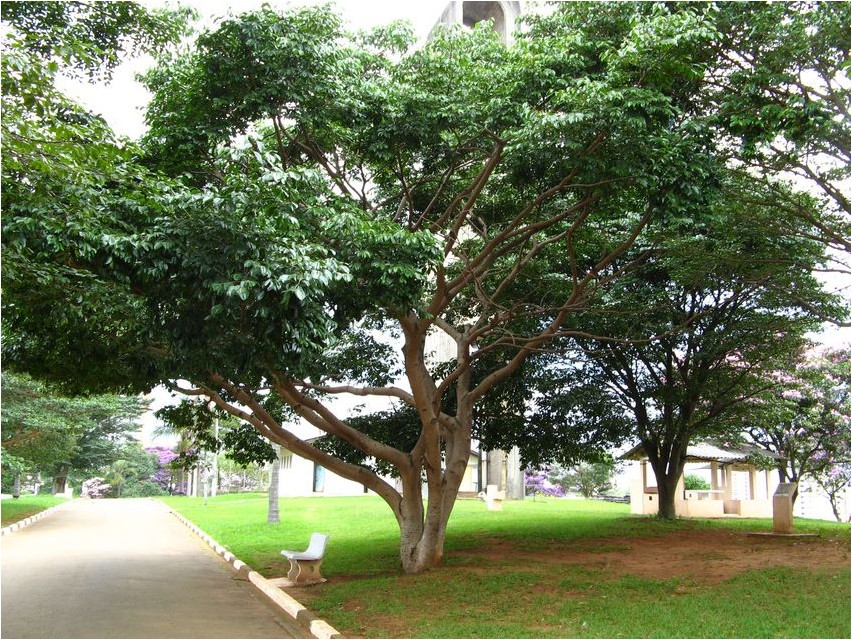
Jatoba (Latin: Hymenaea courbaril) is a woody plant belonging to the legume family, often called jatoba.
Description
Jatoba often reaches a height of forty meters. This plant also boasts an unusually broad crown and straight, cylindrical trunks. Its young shoots are densely covered with numerous brownish hairs. Jatoba”s rough-skinned leaves are matte beneath and glossy above. They are characterized by a complex structure: each leaflet is formed by two leaflets—one pointed and one broadly sickle-shaped—and their length reaches seven to eight centimeters.
Jatoba”s white flowers, gathered in fairly long panicles (sometimes these panicles can reach fifteen centimeters in length), have five petals and the same number of grayish-green sepals. Jatoba fruits are beans, averaging fifteen centimeters in length. Each bean is enclosed in an individual shell, which becomes woody and acquires a characteristic dark brown color as it ripens. Each fruit contains one to six seeds, which can be elliptical or spherical. Inside each seed are tiny white kernels, covered on the outside by a rather rough, reddish-brown shell. Furthermore, all the seeds are surrounded by a starchy, yellowish-greenish pulp. This pulp is considered very nutritious, as it contains a significant amount of starch. It has a slightly sweet taste, but its odor is very unpleasant. The taste of jatoba itself is somewhat reminiscent of powdered milk.
Where it grows
In its natural state, jatoba grows in several Central and South American countries (for example, Brazil). It can sometimes also be found in the West Indies. In these countries, jatoba is often referred to as a Brazilian or South American plum or cherry. However, it is completely unrelated to either plum or cherry, belonging to a completely different family.
Uses
Jatoba can be eaten fresh or cooked. The pulp is also widely used—it”s used to make not only baked goods but also some other dishes. A very unique alcoholic drink is produced by fermenting the crushed pulp with water.
The amazingly beautiful crown makes jatoba a very decorative crop, and its wood is used for the manufacture of high-quality parquet, furniture, stairs, sports equipment and a wide variety of carpentry. Such wood is excellent at drilling, sanding and sawing, and in general it is suitable for almost any carpentry work. It is especially valued by carpenters, cabinetmakers and shipbuilders. By the way, it is quite acceptable to use wood for the construction of terraces, however, in this case it may be prone to cracking.

In the process of life, fruit trees secrete orange anime resin — oxidizing over a very long period of time in the air, this resin turns into a mass that looks very similar to amber. True, this unusual trees require millions of years. The resin is so sticky that any insect that accidentally falls into it remains encapsulated in it forever. It was thanks to this resin and the insects that periodically fell into it that scientists were able to prove the long-standing existence of not only the jatoba itself, but also a great variety of different insects.
Contraindications
Jatoba contains substances that have a fairly high degree of allergenicity, so it does not hurt to exercise some caution when consuming it.
Interesting Brazil in Nazarov style. Jatoba or Jatoba (jatob& aacute;)