Hazel
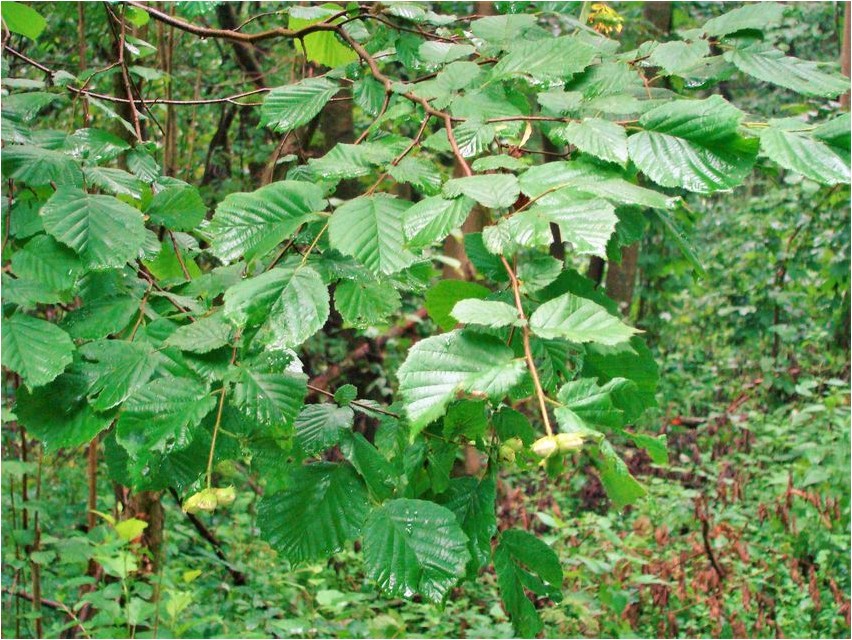
Hazel (lat. Corylus) is a tall, winter-hardy tree that is a representative of the Birch family. Other names are hazel or hazelnut. As for the name hazelnut, this is the commercial name of a number of varietal forms.
Description
Hazel is a deciduous shrub or tree (trees are much less common), the height of which ranges from three to six meters. The broadly oval pubescent leaves of this plant near the apexes usually taper to a point or may be briefly pointed. In total, the hazel genus includes about fifteen to twenty species.
Where does it grow
Hazel is especially widespread in temperate latitudes in Europe, North America and East Asia. By the way, common hazel is found in forests throughout Europe!
Usage
In horticulture, the most widespread and unfailingly popular species is the common hazel, grown both as an ornamental and as a nut crop. However, some decorative varieties of hazel are no less readily grown — with winding shoots (the Contorta variety), as well as with green leaves (Antey, Komsomolets, Pervenets and Tambovsky early) and with red leaves (Moscow ruby with very large fruits, Moscow early, Ivanteevsky red, Akademik Yablokov, as well as the Red Majestic variety with spectacular purple catkins and twisted branches).
Red-leaved forms of hazel are quite often and actively used in landscaping in compositions with some other ornamental plants. In addition, this plant is often used to secure slopes and line roads. And in Europe you can often see hazel trees planted with a weeping crown shape, as well as hazel trees with spotted, white-edged or golden leaves!
Hazel branches are often harvested for livestock feed, and its wood is very successfully used for making small turning and carpentry items. By the way, it is from hazel wood that the medicinal liquid “Lesovaya” is obtained by dry distillation, which has proven itself in the treatment of eczema and a number of different skin ailments. Hazel sawdust is used in the Caucasus to clarify coarse or cloudy wines, as well as to clarify vinegar, and the bark of these trees, containing more than eight percent tannins, is suitable for dyeing and tanning leather.

Growing and care
Hazel will feel great either in sunny or semi-shaded areas — as a rule, green-leaved and red-leaved forms grow well in open areas, but golden varieties require slight shading. As for the soils for planting hazel, they should be rich and well supplied with moisture. But saline, sandy and swampy substrates must be avoided in every possible way. And, of course, good drainage is a must! It is best to plant hazel trees in the fall, while trying to avoid deepening the root collar.
Hazel trees should be watered rarely, but at the same time quite abundantly. And with the onset of autumn, the tree trunk circles must be mulched with humus. Feeding will also be needed: every year the plant is pampered with high-quality mineral fertilizers, in addition, fertilizing with organic matter, which is carried out every two to three years, will not be superfluous.
Every few years, mature hazel bushes are thoroughly thinned out, trying to leave no more than six to ten strong, but not old, evenly spaced trunks.
Despite the fact that in general hazel can boast of very impressive winter hardiness, sometimes the flowers of this plant can still suffer from spring frosts.
As for hazel propagation, its decorative forms are almost always propagated vegetatively (by grafting, layering or root suckers).