Arable clover
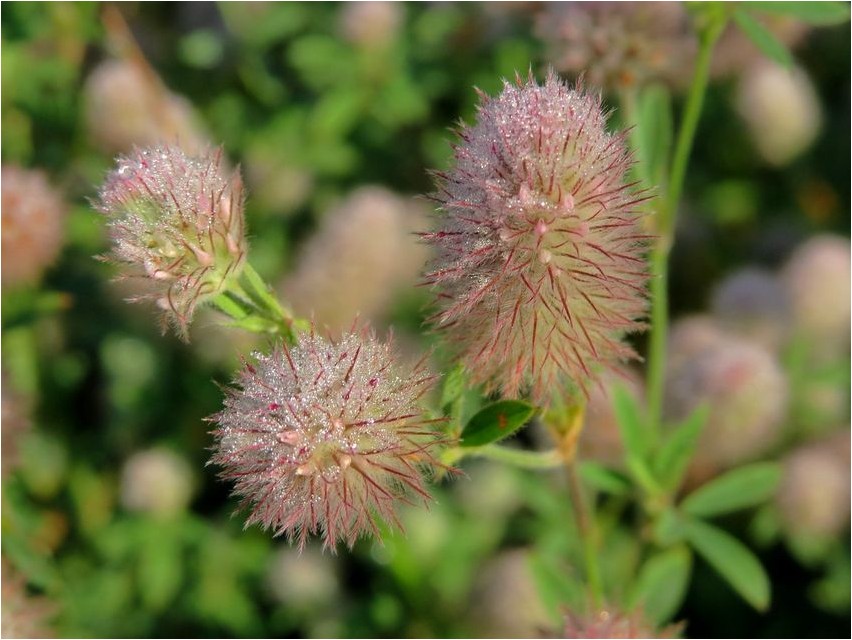
Arable clover is one of the plants of the family called legumes; in Latin the name of this plant will be as follows: Trifolium arvense L.
As for the name of the arable clover family itself, in Latin it will be: Fabaceae Lindl.
Description of plowed clover
Arable clover is also known by the popular name cats. Arable clover is an annual plant endowed with straight, branched, densely pubescent stems, the height of which will vary between ten and thirty centimeters. The leaves of this plant are stem only, they are compound and trifoliate, and are also endowed with linear-oblong and finely toothed leaves. The flowers of this plant have a very small corolla, painted in pale pink tones. Such a corolla will be hidden in the very depths of the cup. The heads of cultivated clover appear quite fluffy due to the long, hairy teeth of the calyx, which will persist during fruiting. The fruit of arable clover is a single-seeded leathery bean.
This plant blooms in the summer. Under natural conditions, this plant will be found in the territory of the European part of Russia, in the south of Western Siberia, and as an alien plant, arable clover is found in the Caucasus, Belarus, the Far East and Ukraine. For growth, this plant prefers dry forests, clearings, arable lands, dry meadows, mainly on sandy loams and sands.
Description of the medicinal properties of plowed clover
Arable clover is endowed with very valuable healing properties, and it is recommended to use the grass of this plant for medicinal purposes. The term grass includes stems, leaves and flower heads. Such raw materials of plowed clover should be harvested from June to July.
The presence of such valuable healing properties should be explained by the content in the herb of this plant of tannins, tridomin glycoside, quercetin, resinous substances, essential oil, vitamins C and E, as well as a small amount of alkaloids and some other substances. The herb of this plant is endowed with very effective anti-inflammatory, antiseptic, astringent, analgesic, diuretic and hypoglycemic effects.

As for traditional medicine, an infusion prepared from the herb of this plant has become quite widespread. This remedy is recommended for use for diarrhea, dysentery, migraines, neuroses, kidney and bladder diseases, choking, diabetes, bronchitis, and also for colitis in children. Poultices from this plant can also be used externally for rheumatism, gout, coughs and chest pain, and a decoction based on arable clover should be used to wash ulcers and purulent wounds.
For allergic dermatitis, it is recommended to use the following remedy based on cultivated clover: to prepare such a remedy, you will need to take three teaspoons of dry herb per glass of boiling water. The resulting mixture should be boiled for one hour in a sealed container, after which this mixture based on arable clover should be filtered very carefully. Take this remedy in slow sips of one third or one fourth of a glass twenty minutes before starting a meal four times a day.
For pain-relieving poultices, use the following remedy: take about three to four tablespoons of clover herb and brew it with boiling water, and then wrap the resulting mixture in gauze. To wash purulent wounds, use the following: take three tablespoons of dry clover herb in two glasses of boiling water and leave for one hour, and then filter this mixture.





