Southern Siberian Hedysarum
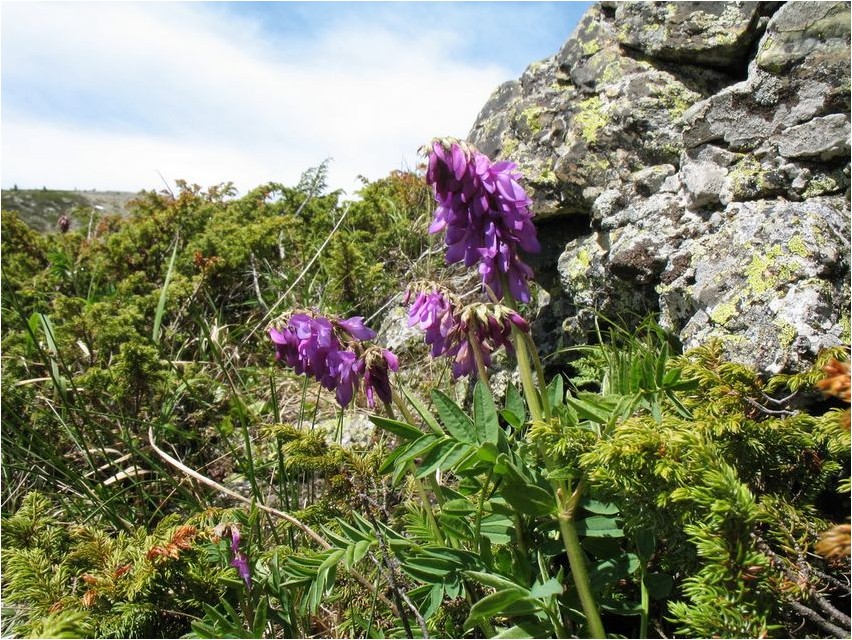
Siberian Hedysarum is a member of the legume family, the Latin name for this plant being Hedysarum austrosibiricum B. Fedtsch.
As for the family name of Southern Siberian Hedysarum, the Latin name is Fabaceae Lindl.
Description of Southern Siberian Hedysarum
Siberian Hedysarum is a perennial herbaceous plant with a thickened, deep-growing root. Several stems extend upward from the root collar, varying in height between twenty and sixty centimeters. The stems of Southern Siberian Hedysarum are nearly erect or slightly ascending, sturdy, and almost glabrous. Numerous fused stipules, colored brown, are found at the very base of the stem. Slightly higher up on the stem of this plant are green leaves that form two to four internodes. At the very base of the Siberian sweetvetch, each short-petiolate leaf has two fused, appressed-hairy stipules, colored brown. The flower stalks of this plant are apical and straight, most often slightly curved, and their length is about eight to twelve centimeters. At the very beginning of the flowering period, the racemes of Siberian sweetvetch will be compressed. There are only twenty to thirty flowers, they will be slightly drooping, and the peduncles will be slightly fluffy. The corolla is colored in lilac tones. The ovary of Siberian sweetvetch is linear, and there will be four to eight ovules.
The fruits of this plant are pods on a peduncle. The segments of these pods will be reticulated and almost round, sometimes they can be oblong. These fruits will have broad wings along the edges. The flowering period of the Southern Siberian Hedysarum occurs from June to July. In the wild, this plant is found in Central Asia, the Altai region of Western Siberia, and also in the following regions of Eastern Siberia: Dauria, Lena-Kolyma, Yenisei, and Angara-Sayan. It prefers subalpine and forest meadows, as well as high-altitude areas on lichen-gravelly mountain peaks.
Description of the medicinal properties of the Southern Siberian Hedysarum
South Siberian kopek is endowed with very valuable healing properties, and it is recommended to use the roots of this plant for medicinal purposes. Such raw materials should be harvested in the autumn. The plant should be dug up and placed in heaps, which is done for the purpose of warming the roots. After this, such roots should be separated from the stems, cutting off the small roots.
The presence of such valuable healing properties should be explained by the content of betaine, choline, 2, 4-dihydroxy-5, 6-dimethoxyisoflavone, as well as linoleic and folic acid in the plant.

It has been proven that decoctions based on the root of the South Siberian kopek are endowed with the ability to lower blood pressure and will also have a very pronounced diuretic effect.
For general weakness, diarrhea, prolapse of the uterus, severe sweating, general weakness, chronic ulcers, swelling of the body, chronic inflammation of the kidneys and non-healing wounds in the mouth, it is recommended to use powdered root mixed with honey. At the same time, it is recommended to take twelve and a half grams of honey for fifty grams of the roots of this plant. About fifteen grams of the finished product should be used per day, with the maximum dose being sixty grams. It should be noted that this remedy is quite effective when used correctly.





