Heteropappus altaicus
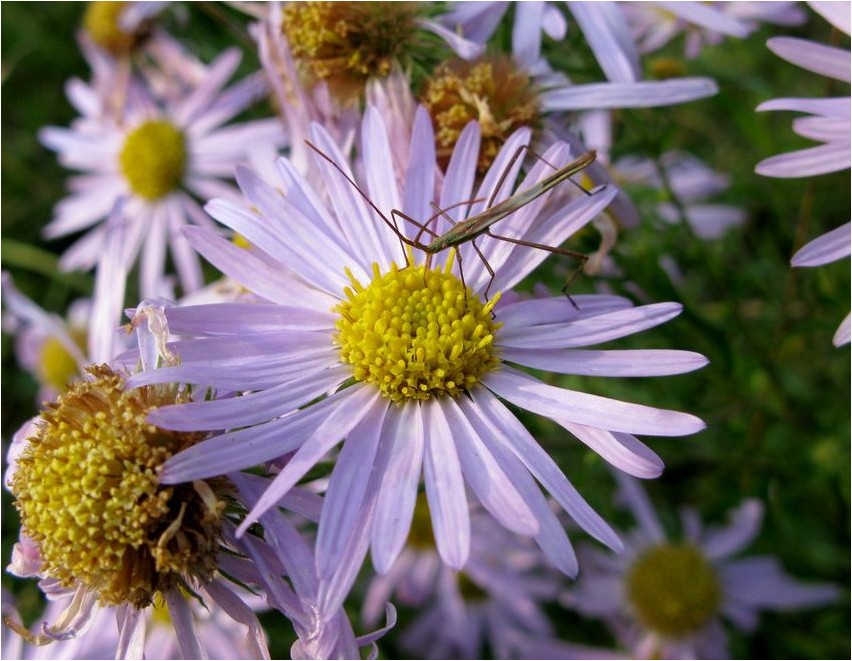
Heteropappus altaicus is a member of the Asteraceae family. Its Latin name is Heteropappus altaicus (Willd.) Novopokr.
The family name of Heteropappus altaicus is Asteraceae Dumort.
Description of Heteropappus altaicus
Heteropappus altaicus is a perennial herbaceous plant that grows to a height of approximately thirty to sixty centimeters. Its stems are spreading and branched, with shortened branchlets in the leaf axils. Furthermore, the stems of Heteropappus altaicus can be either erect or ascending, covered with upward-facing hairs.
The leaves of this plant are either sessile, linear, or linear-oblong. The leaves gradually taper toward the base, and at the apex, they can be either blunt or shortly pointed. Both sides of the leaves of the Altai Heteropappus are pubescent with fine hairs and numerous small, shiny glands. The uppermost leaves of this plant gradually diminish in size. The flowers of the Altai Heteropappus are collected in numerous capitula with ligulate petals up to three and a half centimeters in diameter. These capitula are then joined together to form a corymbose-paniculate inflorescence. The leaflets of the arbors are three-rowed, finely glandular, and finely pubescent. The outermost leaflets are linear and shorter than the leaflets of the inner rows. The ligulate flowers of the Altai Heteropappus are colored either lilac or pale blue, and their width is approximately two to two and a half millimeters. The achene fruits are two to three millimeters long, oblong-obovate, and hairy, with a pappus that can be either pale brown or whitish.
This plant blooms from July to August. In the wild, this plant can be found in Central Asia, Western and Eastern Siberia, as well as China and Mongolia. Heteropappus altai prefers rocky, gravelly slopes, as well as steppe and saline meadows.
Description of the medicinal properties of Heteropappus altai
This plant is endowed with very valuable healing properties, and for medicinal purposes it is recommended to use the inflorescences and grass of Heteropappus Altai. The plant contains rubber, alkaloids, coumarin, flavonoids, terpenoids and saponins.

It should be noted that the aerial part of Heteropappus Altai is endowed with protistocidal and antibacterial activity. In Tibetan and Mongolian medicine, infusions and decoctions prepared from the herb of this plant are used as an anti-inflammatory and antipyretic agent, and they are also used for respiratory infections, measles and smallpox.
As for traditional medicine, an infusion and decoction of the herb of this plant is used as an expectorant. In addition, as experimental studies have confirmed, this plant is part of a collection that has a wound-healing effect. In Tibetan medicine, an infusion of heteropappus altai inflorescences is used for various respiratory diseases, as well as for a number of stomach diseases, including ulcers. In Chinese medicine, along with other medicines, remedies based on this plant are used to treat chronic bronchitis and hemoptysis, as well as sexual weakness in men.





