Capers
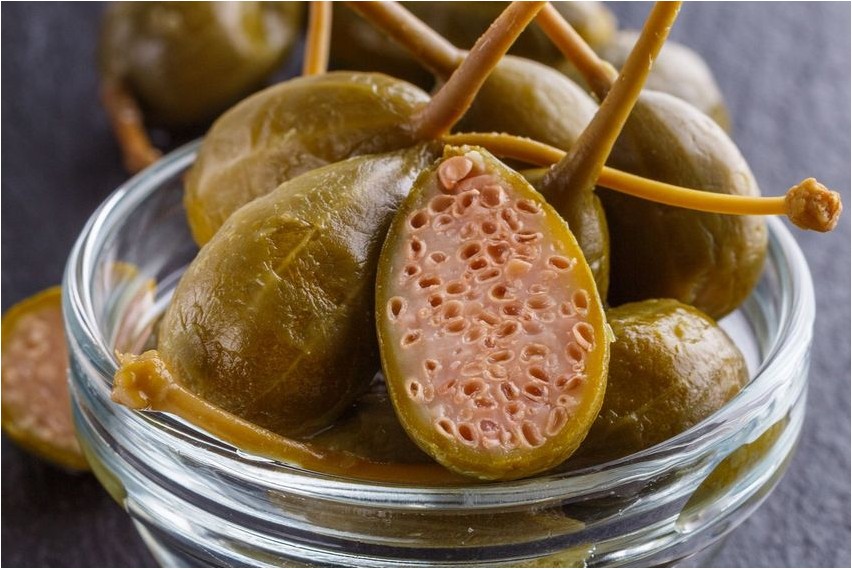
Capers (lat. Capparis) are a vegetable crop belonging to the Caperaceae family. True, sometimes they try to attribute this crop to the Cabbage family. Southern Europe and North Africa are considered the homeland of this unusual plant.
Description
Capers are rather thorny, creeping shrubs ranging from one to two meters in height.
Unopened flower buds and caper fruits are eaten. Most often they are canned or pickled in salt and vinegar. The taste of capers is spicy and quite piquant, as well as slightly mustardy and slightly tart. And their strong aroma is due to the presence of mustard oil in them, obtained by grinding the juicy stems. Most often, capers are used as a side dish or seasoning.
It is noteworthy that ripe fruits from caper bushes can also be consumed raw. Externally, they are pod-shaped berries endowed with reddish pulp, vaguely reminiscent of miniature striped cucumbers. But unopened buds are not suitable for raw consumption.
The larger the caper buds, the tastier, more expensive and easier to use they will be.
Composition
Capers are a real storehouse of minerals and vitamins: they contain fiber, fats, proteins, vitamins (A, B, C, D, E, K), as well as calcium, phosphorus and iron.

Useful properties
Capers are not without beneficial properties. The bark of this plant helps get rid of rheumatism (in addition, it is useful to chew it for toothache), and a decoction of its roots will become an indispensable aid for diseases of the liver (in particular, hepatitis) and spleen.
If you chew caper seeds, your headache will go away pretty quickly. And the fancy fruits, rich in iodine, are widely used to treat goiter (for this, the juice of freshly picked fruits is diluted with water and consumed several times a day).
Decoctions and infusions of young leaves and sprigs of capers will alleviate diabetes, and the juice of the plant will be useful for the treatment of non-healing wounds.
The rutin contained in capers allows them to be used with high blood pressure, and the essential oil extracted from the seeds of the plant is used as a massage oil.
Capers also help protect the body from cancer. They are especially useful for women.
Growing and care
To grow this crop, you should choose open sunny areas characterized by a complete absence of groundwater.
Capers do not have any special requirements for soil fertility — they grow equally well in heavy soils and even in wall crevices. And the plant’s incredibly strong rhizomes can withstand almost any frost. In addition, capers do not need constant replanting — they can easily grow in the same place even for fifteen years.
Capers can be propagated by seeds, layering or shrub pieces. Seeds begin to be sown in March or early April. And in order for capers to grow better, it is recommended to plant them on sandy soil (deep to about 30 centimeters) or in greenhouses. It is important to try to ensure that the row spacing is approximately half a meter or even a meter.
The most important thing when growing capers is to get seedlings, since even with very good care, these plants sprout extremely poorly and take root rather poorly. So spectacular flowering shrubs can be seen on the site only in a couple of years.
As for care, capers are very unpretentious in care — watering and weeding are enough for them. True, occasionally you can supplement maintenance measures with loosening the soil. And, of course, you need to systematically get rid of weeds.





