Brighamy
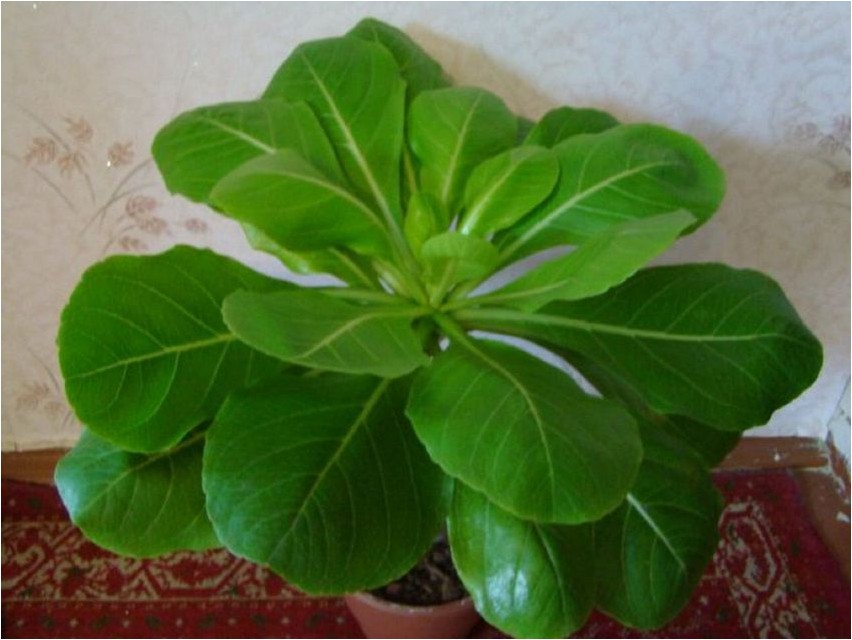
Brighamia is a genus of plants that belong to the family called Campanaceae. The plant is a leafy succulent; in its homeland this plant is known as volcano palm, cabbage on a stick, or even Hawaiian volcano palms.
Description of Brighamy
This plant grows naturally in the Hawaiian Islands. It is noteworthy that this plant cannot in any way be compared with palm trees. Under natural conditions, Brigamia grows near rocky cliffs on the coast, very high above sea level – about five hundred meters. This plant is an endangered species in nature, but in indoor culture, Brigamia is quite common.
When people came to the Hawaiian Islands, new species of flora and fauna appeared there, which were brought there from the continents. Actually, it was then that the struggle for survival in Hawaii began: then many plants and various species of animals won, which caused immeasurable damage to the flora of the Hawaiian Islands. Thus, a very special species of hawkmoth butterflies, which have special adaptations that help pollinate brigamias, disappeared from the Hawaiian Islands. Such a device is a long and rather thin proboscis. Brighamia is not able to be pollinated by any other insects, and the plant itself does not form seeds. In the modern world, attempts are being made to artificially pollinate Brigamia, but this requires special efforts. For this reason, they try to grow Brighamia indoors as often as possible in order to prevent the extinction of this genus, and subsequently it is possible to return the plant to natural conditions.
Two species of this amazing plant grow in natural conditions: Brigamia rocky and Brigamia remarkable. Brighamia remarkable is endowed with a thickened trunk-stem; this stem does not branch. At the very base, the trunk thickens and takes on a very peculiar bulb shape, and at the top of this trunk there will be a rosette of leaves that have a waxy-glossy coating and are colored either in bright salad or light green tones. The length of the leaf blade of this plant will be about twelve to twenty centimeters, while the width will range from six to twelve centimeters. As for Brigamia rocky, its height will be lower, while Brigamia remarkable can reach a height of one to two meters.
Care and cultivation of brigamia

Under natural conditions, the plant is found in dry and rocky forests, where the soils are poor and rocky. However, there is very little rainfall here each year. For this reason, brigamias are able to retain moisture for a very long time and not waste it; even with a large leaf area, evaporation does not occur intensively.
However, Brighamias are considered low-maintenance plants; they only require good soil drainage. The pot should not be deep, but rather wide, and there should be sufficient drainage at its bottom. As for the soil, you will need the following soil: garden soil, loamy soil and a large amount of sand. Such soil should not only get wet well, but also dry out quite quickly.
The plant should be watered only when the earthen ball is completely dry. However, watering should be plentiful, and excess water should drain into the trays. After half an hour after watering, you should drain the water from the pan. It is not recommended to allow stagnation of moisture under any circumstances, because otherwise the plant may simply die. As for particularly hot temperatures, on such days it will be necessary to spray the leaves every day. if in winter the air is also dry, then you will need to spray the brigamia from time to time.