Datura stramonium
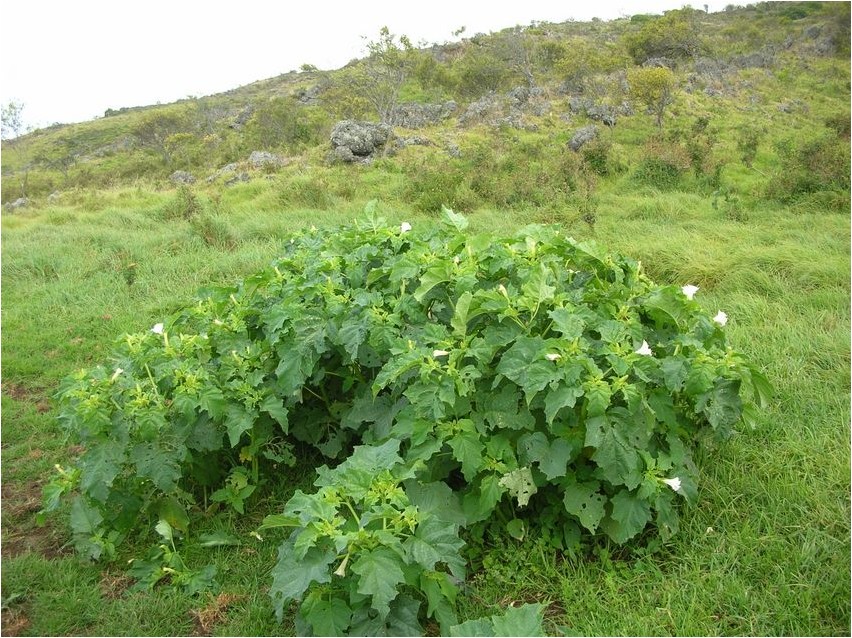
Datura stramonium is a member of the Solanaceae family. Its Latin name is Datura stramonium L.
As for the family name itself, the Latin name is Solanaceae Juss.
Description of Datura stramonium
Datura stramonium is an annual herbaceous plant with a spindle-shaped, erect, slightly branched root. The upper part of the stem is branched. The leaves are alternate, long-petiolate, arranged in pairs, and can be either elongated-ovate or ovate. These leaves can be either serrated or notched-lobed; they have pointed lobes and teeth, are wedge-shaped at the base, and reach up to twenty-five centimeters in length. The leaves of this plant are dark green above, but grayish-green below. When young, these leaves are finely hairy, later retaining sparse hairs only along the veins. The flowers of Datura stramonium are solitary, axillary or terminal, and quite large and fragrant, white in color. The corolla and calyx are symphylophyllous and pentamerous. The fruits of Datura stramonium are quite large and oval in shape, with four chambers. These fruits are spiny capsules that open with four valves. The seeds are flattened and kidney-shaped, black in color, and have a reticulated surface.
Datura stramonium blooms from June to September. In the wild, this plant is found in the European part of Russia, as well as in the Caucasus, Central Asia, and southern Western Siberia. This plant prefers to grow near homes, in vacant lots, as well as in vegetable gardens and garbage dumps. It’s worth noting that all parts of the Datura stramonium are poisonous, so special care is recommended when handling this plant.
Description of the medicinal properties of the Datura stramonium
For medicinal purposes, it is recommended to harvest the leaves and tops of this plant, which should be done during flowering, while the seeds of Datura are collected in the autumn from ripe fruits. The same leaves that are collected with dew and after rain will turn black quite quickly. The raw materials of this plant are dried in the shade, in dryers or in attics. Such raw materials can be stored for two years.
The presence of such valuable healing properties is explained by the content of alkaloids in the plant: atropine, scopolamine and hyoscyamine. It is noteworthy that the alkaloid atropine in large doses has the ability to stimulate the cerebral cortex, while in smaller doses it will stimulate respiration and act as an antispasmodic.

The leaves of this plant will also contain essential oil, carotene and tannins.
For insomnia, it is recommended to use a very valuable remedy based on Datura vulgare: to prepare such a remedy you will need to take one part of the crushed seed to five parts of seventy percent alcohol. The resulting mixture should be infused for seven days, and then the mixture is carefully filtered. Take this remedy two drops per two tablespoons of water four to five times a day.
A decoction of the leaves of this plant is used as sitz baths for prolapse of the uterus and rectum, and full baths with this remedy are taken for chronic rheumatism. A decoction of the leaves is twenty grams of datura leaves per bucket of water.





