English oak
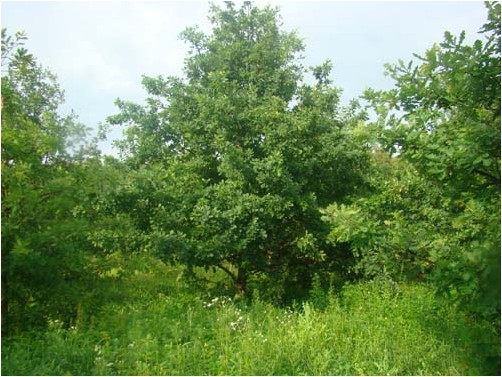
English oak is one of the plants of the family called beech; in Latin the name of this plant will be as follows: Quercus pedunculata Ehrn.
As for the name of the pedunculate oak family itself, in Latin it will be like this: Fagaceae Dumort.
Description of English oak
English oak is a tree whose height is about forty to fifty meters. The table below the top will branch into several thick branches. The shoots of this plant are bare, the buds can be either oval or round. The leaves are endowed with rather long, curved or straight blades. Pistillate flowers and fruits are located on a long stalk, one to three pieces each; the length of such a stalk will be about six to eight centimeters. The top of the pedunculate oak is cup-shaped, its height is equal to one centimeter, sometimes it can be smaller and saucer-shaped. The length of the acorns of this plant is approximately one and a half to three centimeters, they are surrounded by a plus, and the color of such acorns is brownish-yellow.
Petiolate oak blooms from April to May. Under natural conditions, this plant is found everywhere in Russia, Belarus, Ukraine and the Caucasus. It is noteworthy that this plant is one of the main forest-forming species. For growth, petiolate oak prefers places along ravines and mountain slopes, in floodplains of rivers and along ravines. This plant can form pure oak forests or occur in a mixture with other species.
Description of the medicinal properties of English oak
English oak is endowed with quite valuable healing properties, while in homeopathy the plant is used for alcoholism, as well as for tumors of the liver and spleen.
As for traditional medicine, a decoction based on this plant is quite widespread. This decoction is recommended for use in rickets and tuberculosis. An ointment is prepared from the bark of the English oak tree, which is used to treat frostbite. An infusion and decoction of the leaves of this plant is used to treat diabetes.

For tuberculosis, it is recommended to use the following quite effective remedy based on pedunculate oak: to prepare it you will need to take one tablespoon of crushed bark of this plant per glass of water. The resulting mixture should be boiled over low heat for ten minutes, then left to steep for one hour, after which the mixture is added to the original volume using boiled water. This remedy is taken one or two tablespoons three times a day.
For diabetes mellitus, using a remedy based on pedunculate oak is also quite effective: to prepare such a remedy, you need to take one tablespoon of pedunculate oak leaves per glass of boiling water. The resulting mixture should be infused for two hours, and then this mixture is left to infuse for two hours, after which it is carefully filtered. Take this remedy based on pedunculate oak, two tablespoons three to four times a day.
As for the bark of this plant, it is used as an antiseptic, astringent and anti-inflammatory agent. A decoction of pedunculate oak bark is used in the treatment of inflammation and gum disease, sore throat and stomatitis, and in addition, this remedy also helps eliminate bad breath. For burns, it is recommended to apply compresses, as well as for ulcers, wounds, frostbite, dermatitis and various skin diseases. An infusion of the bark of this plant is recommended for use for heavy menstruation, diarrhea and gastrointestinal bleeding.





