Mallow whorled
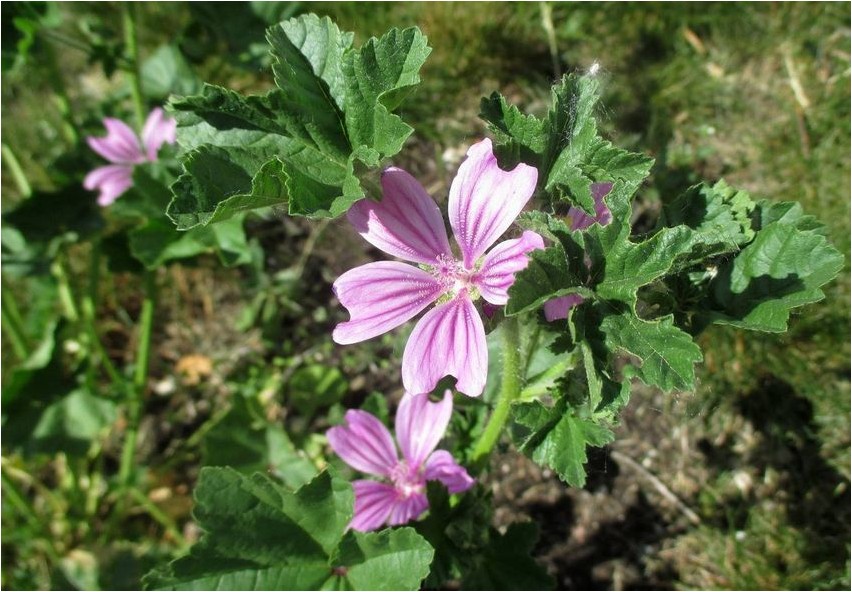
The whorled mallow is one of the plants of the family called malvaceae; in Latin the name of this plant will be as follows: Malva verticillata L. (M. meluca Fraebn.) P. Medw.
As for the name of the whorled mallow family itself, in Latin it will be like this: Malvaceae Juss.
Description of whorled mallow
The whorled mallow is an annual herbaceous plant whose height will vary between two and three meters. The stem of this plant will be straight and cylindrical; it can be either weakly branched or simple. At the base, the diameter of this stem will be about two centimeters, it can be either very sparsely hairy or bare. The leaves of the whorled mallow will be quite large in size, the leaf blades are rounded, they are painted in bright green tones, on top such leaves will be bare and shiny, and on the bottom they are endowed with appressed hairs and an anthocyanin spot. Such leaves of the whorled mallow will be five to seven lobed. The flowers of this plant are located on very short stalks, and are also arranged several in fairly dense balls in the axils of the leaves. The corolla of the whorled mallow will be one and a half times larger than the calyx, and it will be colored in lilac-pink or pale pink tones. The fruits of this plant consist of ten to eleven pale fruitlets.
The flowering of the whorled mallow occurs in the period from June to August, while the fruits ripen in July-November. Under natural conditions, this plant is found in the European part of Russia. As a weed, the whorled mallow grows in gardens, orchards and crops.
Description of the medicinal properties of whorled mallow
The whorled mallow is endowed with very valuable healing properties, and it is recommended to use the seeds, roots and herbs of this plant for medicinal purposes. The term grass includes flowers, stems and leaves. It is recommended to explain the presence of such valuable healing properties by the content of mucus in all parts of this plant, while carbohydrates will be present in the roots and stems, and the seeds contain fatty oil. The leaves of this plant contain carbohydrates and fatty oil, which in turn contains linolenic, oleic and linoleic acids.
A decoction prepared from the herb of whorled mallow is recommended for use for diarrhea and anuria. A decoction based on the roots of this plant is indicated for use in whooping cough. As for traditional medicine, leaf ash, which is used to treat scabies, is considered quite effective.

It is noteworthy that Tibetan medicine recommends using the aerial part of the whorled mallow as part of various preparations. Chinese medicine uses a decoction made from the seeds of this plant to treat breast cancer. It should be noted that the fiber from the stems of this plant is quite suitable for coarse spinning, and the oil is used in soap making.
It is noteworthy that this plant is a forage crop that is considered quite promising in the forest-steppe, forest and humid regions of Ukraine and the North Caucasus, north-west Russia and the northern regions of Western Siberia.
For diarrhea, it is recommended to use the following very effective remedy based on this plant: to prepare such a healing remedy, you will need to take two tablespoons of dry crushed mallow herb per three hundred milliliters of boiled water. The resulting mixture should first be boiled for about three minutes, then left for an hour and filtered thoroughly. Take this healing remedy based on whorled mallow three to four times a day, two tablespoons.





