Pedicularis dasystachys
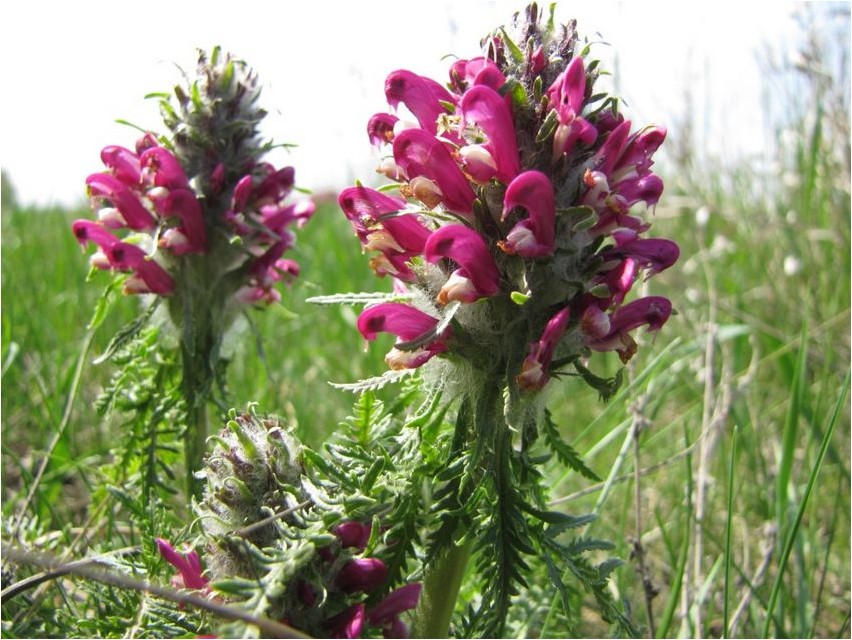
Pedicularis dasystachys is a member of the Scrophulariaceae family. Its Latin name is Pedicularis dasystachys Schrenk. (P. laeta Stev. ex Glaus).
As for the family name of Pedicularis dasystachys, the Latin name is Scrophulariaceae Juss.
Description of Pedicularis dasystachys
Pedicularis dasystachys is a perennial herbaceous plant, growing between ten and thirty centimeters in height. This plant is also semi-parasitic. Its roots are shortened, with thick, cord-like lobes, and its stems are simple and straight. The basal leaves of the Lousewort are borne on shiny, downy rootlets, with the upper leaves sessile. The inflorescence of this plant is subcapitate, dense and loosely tufted, and tufted, white-downy, reaching fifteen centimeters in length. The corolla of the Lousewort is either white or bright pink, glabrous, and features a straight tube and a slightly tilted casque. Its length is approximately twenty-two to twenty-five millimeters. The lip of this plant is broadly oval and finely serrated, and its width is seven to eight millimeters. The capsule of the Lousewort is ovoid, and its length is approximately eight to ten millimeters.
This plant blooms in May, and fruiting occurs in June. In the wild, Locust’s hairy-spiked lousewort is found in Central Asia, Western Siberia, Ukraine, and European Russia. This plant prefers solonetz, alkaline, and flooded meadows. It is noteworthy that this plant is not only an insecticide but also a honey plant.
Description of the medicinal properties of Locust’s hairy-spiked lousewort
Locust’s hairy-spiked lousewort has very valuable medicinal properties, and it is recommended to use the herb of this plant for medicinal purposes. The herb includes the flowers, leaves, and stems. This plant has very effective anti-inflammatory, diuretic, hemostatic, and cardiotonic properties.
It’s worth noting that an experiment demonstrated that an infusion prepared from the herb of Lomus villosa has the ability to increase blood pressure and also exhibits cardiotonic properties. It’s worth noting that this plant is recommended for clinical trials as a cardiotonic agent.

Aqueous and alcoholic extracts of Lomus villosa have pressor, diuretic, cardiotonic, and choleretic effects, and also stimulate gastrointestinal motility.
This plant is also widely used in folk medicine. An infusion prepared from the herb of Lomus villosa is recommended for use in lumbago and acute sciatica. The following remedy based on this plant is recommended as a diuretic, antipyretic, and hemostatic agent: to prepare this remedy, take one tablespoon of the flowers of the marsh lousewort per one cup of boiling water. The resulting medicinal mixture should be left to steep for approximately one hour, then carefully strained. Take this remedy based on the marsh lousewort, one to two tablespoons three times a day. It should be noted that when used correctly, this remedy is very effective.
Marsh lousewort. Plant Handbook
https://www. youtube. com/watch? v=Q0uez0I4cxs
Marsh lousewort (Molewort)





