Kalmia latifolia
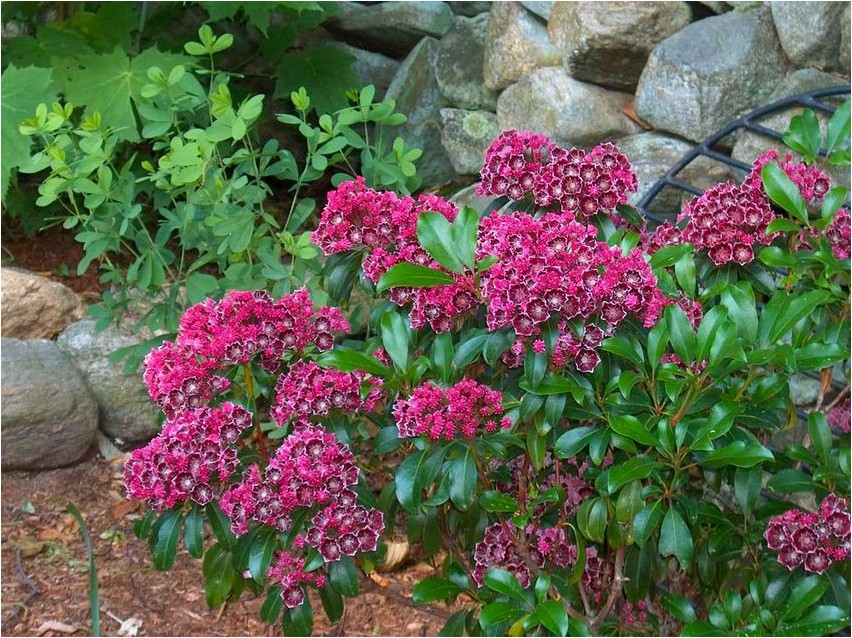
Kalmia latifolia is an evergreen plant of the genus Kalmia, which belongs to the Ericaceae family.
It grows naturally as shrubs with numerous gnarled trunks or small trees. The plant”s stems are adorned with broad, glossy leaves year-round, and spring brings a vibrant display of flowers that lasts for several weeks.
What”s in a name
Although Kalmia latifolia was first seen by European sailors who “discovered” America in 1624, it received its Latin name only in the 18th century, when the Swedish botanist Carl Linnaeus began classifying all plants. The entire genus of plants was then given the name “Kalmia,” commemorating the name of one of Carl Linnaeus”s students, Per Kalm, who domesticated exotic American plants in Northern Europe.
The plant”s specific name, “latifolia” (broadleaf), is self-explanatory, distinguishing this species from narrow-leaved, multi-leaved, and box-leaved plants.
The plant has many common names, such as “Mountain Laurel,” because Kalmia latifolia grows wild on rocky slopes and in mountain forests; or “Spoon Tree,” because Native Americans make dinner spoons from the wood of shrubs and trees.
Description
This small tree or multi-stemmed shrub with intricately curved trunks can be found in a wide variety of locations across North America: in cool meadows, woodlands, and rocky mountain slopes. Since Per Kalm began cultivating plants of the genus named after him in Europe, gardeners have fallen in love with this easy-to-grow shrub with its beautiful spring blooms, and it has become firmly established in its new location.

The alternate, elliptical leaves resemble those of Rhododendrons, also members of the Heather family. For twelve months a year, they adorn the dense, rounded bushes with their glossy, leathery, dark green surface. The underside of the leaves is yellow-green.
In late May or early June, flowers appear in whorls of foliage, forming numerous corymbose inflorescences that simply encircle the bush with a picturesque bloom. Each flower, with five petals folded into a miniature cup, is a natural work of art. The petals range in color from white to pink with purple markings within.
The flowers are replaced by inconspicuous brown fruits, dehiscent capsules that hang on the bushes all winter.
All parts of Kalmia latifolia are highly toxic.
Growing
Kalmia latifolia tolerates a wide range of lighting conditions. It grows well in both full sun and full shade. But a more favorable environment for the plant will still be partial shade, when the bush is exposed to the rays of the sun from morning to lunch, and is covered with shadow in the afternoon.
Unpretentiousness to soils excludes only heavy clay soils, on which Kalmia latifolia refuses to grow. An important condition for successful development is good soil drainage.
To maintain the decorative appearance of the plant, faded inflorescences should be removed. After the end of the flowering period, the bush should be lightly trimmed to promote its lushness.
Usage
In terms of its decorative properties, Kalmia broadleaf is equated by gardeners to Rhododendrons and Azaleas (the latter are classified as an independent genus only by gardeners, and botanists classify Azaleas as belonging to the genus Rhododendron). Indeed, if you don’t look closely at some of the differences, the appearance of the bushes is very similar.
From Kalmia broadleaf bushes you can make a bright and dense hedge, or decorate the area with a separate picturesque specimen.





