Fatshedera
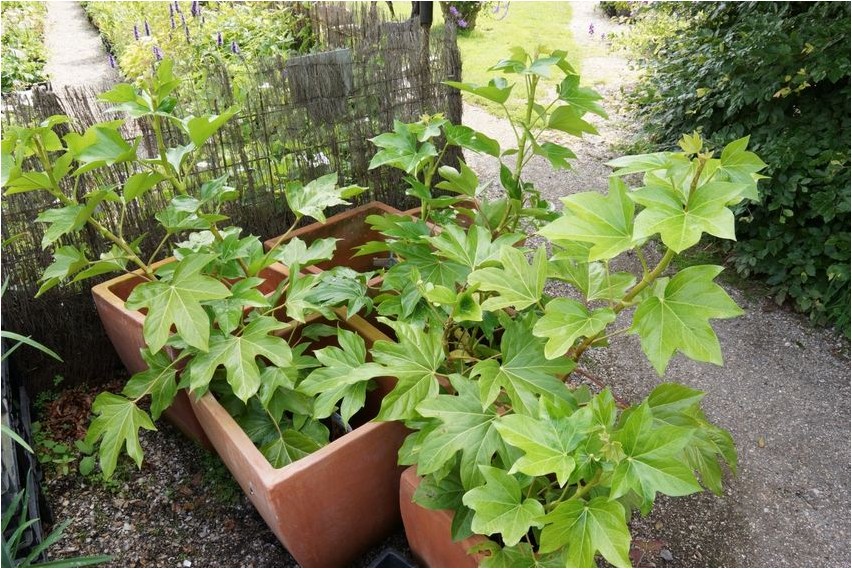
Fatshedera (lat. Fatshedera) is a unique fast-growing plant, obtained in France in 1912 as a result of crossing hedera, that is, ordinary ivy, with Japanese fatsia.
Description
Fatshedera is an evergreen vine, the length of its woody shoots can reach five meters. Initially, its shoots grow upward; they begin to spread only after some time.
The diameter of the large palmate or trifoliate leaves of this plant often reaches thirty centimeters. All of them are leathery and colored in rich dark green tones, and the shape of these leaves is somewhat reminiscent of maple leaves. And the pretty yellowish-greenish flowers of fatshedera are collected in spherical umbrellas or in attractive panicle inflorescences, the length of which easily reaches fifteen centimeters.
Where does it grow
Fatshedera is a plant native to the arid regions of South Africa.
Usage
Fatshedera is the most ideal indoor plant: it boasts truly incredible vitality and relative ease of care, which is why even novice plant growers purchase it with great pleasure.
Fatshedera is especially widely used in compositions for winter gardens, as well as in vertical gardening of balconies and terraces. By the way, in areas with fairly mild winters, this plant can easily grow outdoors.

For indoors, it is best to choose variegated varieties of Fatshedera, as they are much more decorative and at the same time grow much slower. However, in this case, it is important to take into account that such varieties are characterized by high light sensitivity.
Growing and care
Fatshedera can be safely placed on any window, including northern windows. However, one should not discount the fact that this plant will develop best on eastern or western windows. Fatshedera grows with equal success both in bright light and in slight shade. Moreover, it tolerates quite well a variety of disadvantages of care: dust, dry air, as well as short daylight hours in winter.
The temperature of fatshedera in summer and spring should be in the range from twenty to twenty-four degrees, and in winter it can be limited to a range of ten to twelve degrees. The main thing is to provide this beauty with excellent lighting in winter.
Fatshedera should be watered abundantly; in addition, it will be very grateful for regular spraying. And in hot weather, it doesn’t hurt to also sprinkle in the shower. As for fertilizing, they are usually carried out twice a month (only in summer and spring). In addition, in the summer it is recommended to periodically take the fatshedera out into the partial shade and into fresh air.
Young fatshedera are replanted every year with the onset of spring, and for these purposes it is necessary to take sufficiently spacious containers. And adult plants can be replanted once every two or even three years (either in September or spring). As for the soil mixture, ideally it should be formed by two types of soil: leaf and turf, as well as sand (all components are taken in equal parts).
Fatshedera is propagated by apical cuttings. And to support its shoots, small wooden sticks are used. If you want your beautiful plant to always bush, you need to systematically pinch out its shoots.
As for pest damage, fatshedera can be attacked by scale insects and spider mites from time to time.