Fragrant violet
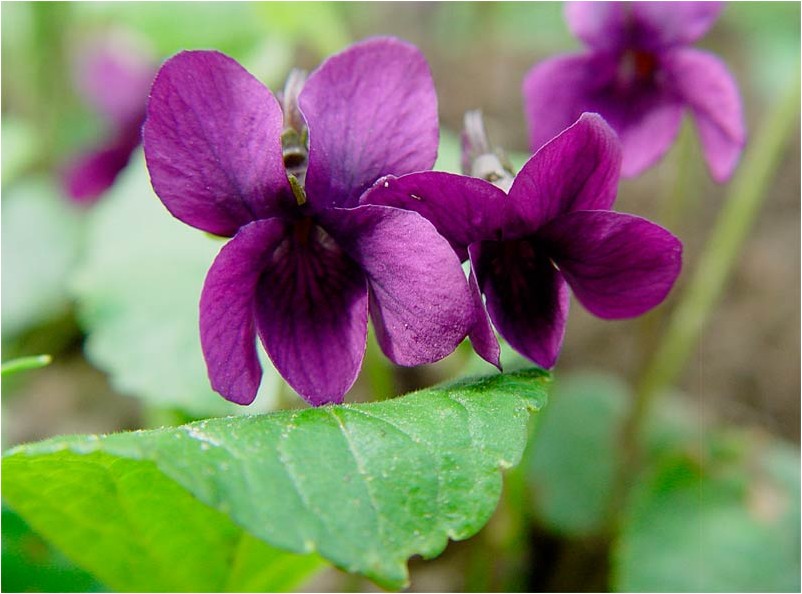
Fragrant violet (lat. Viola odorata) is an elegant perennial herbaceous plant of the genus Violet (lat. Viola) of the violet family (lat. Violaceae).
A compact, delicate and fragrant plant will be an ideal decoration for a rocky garden. Since ancient times, the fragrant violet, not inferior in its abilities to the tricolor violet, has been used by folk healers to combat human ailments.
What’s in your name
The origin of the Latin name of the genus, with which the names of all species of this community begin, has several versions. One of them is the translation of the word “Viola” as “purple”, which is quite appropriate, since most flowers of numerous species are colored in various shades of purple.
The species name “odorata” is based on a shorter word meaning “smell”, hence the Russian translation “fragrant”.
Description
The underground part of the fragrant violet is a creeping thick rhizome, from which a whole network of lateral roots extends. It is this that maintains the longevity of this species, releasing numerous basal rosettes of leaves with long pubescent petioles to the surface of the earth. The Fragrant Violet does not have a stem, as is usual for other plants. They are replaced by so-called stolons – thin and long above-ground shoots that have the ability to take root, creating a whole clump that will bloom the next year.
The basal rosette consists of simple leaves with a crenate-serrate edge, which gives the leaf plate a decorative appearance. The shape of the leaves is round-heart-shaped. A pair of ovate-lanceolate stipules is located at the base of each leaf. The leaves remain green even under the snow, providing a year-round decoration for the perennial plant.

Densely pubescent peduncles bearing single fragrant flowers are born in the axils of the leaves. Flowering occurs twice: in the spring, covering April and May, and a second time towards the end of August. Five sepals and five petals take part in the construction of an irregular (zygomorphic) flower, the symmetry of which takes place only in relation to one possible vertical plane. The petals can be white or different shades of purple. The lower petal of the flower is equipped with a brave spur and is slightly wider than the other four. The side petals look like baby elephant ears. In the center of the flower there is a white spot, on which the purple veins of the lower petal create a bearded geometric pattern. The stamens are hidden behind thin brushes of thick white hairs.
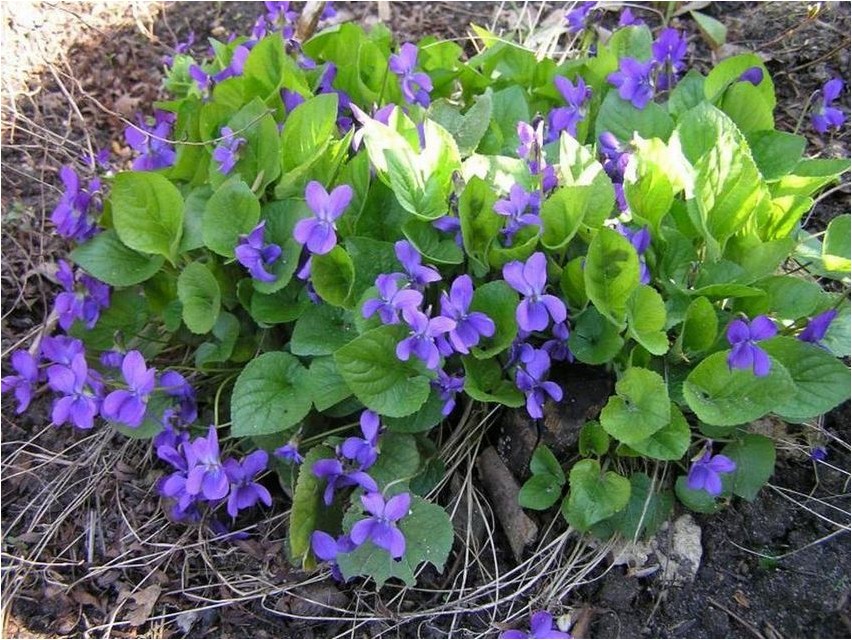
In addition to open-petaled flowers born in early spring, when the tree canopy does not yet provide shade, the sweet violet produces cleistogamous flowers, more like flower buds, within which self-pollination occurs behind “closed doors” during the period when the tree canopies cast a dense shadow on the ground.
The sweet violet is a natural barometer, signaling the approach of rain with its petals, which, sensing inclement weather, press themselves together to protect their reproductive parts from the harmful moisture from the sky.
The fruit is a three-valved, spherical capsule containing small seeds.
Uses
Decorative, year-round green leaves with serrated edges, the playful faces of the petal flowers, the pleasant aroma, and the compact, low-growing rosettes of leaves make the sweet violet a popular plant for rock gardens. Fragrant flowers readily share their nectar with bees.
Since ancient times, the fragrant violet has been used by humans to heal ailments, as evidenced by written sources from ancient times. Its healing properties are so broad that they can normalize the function of virtually any human organ.
Fragrant Violet (King) &





