Japanese dodder
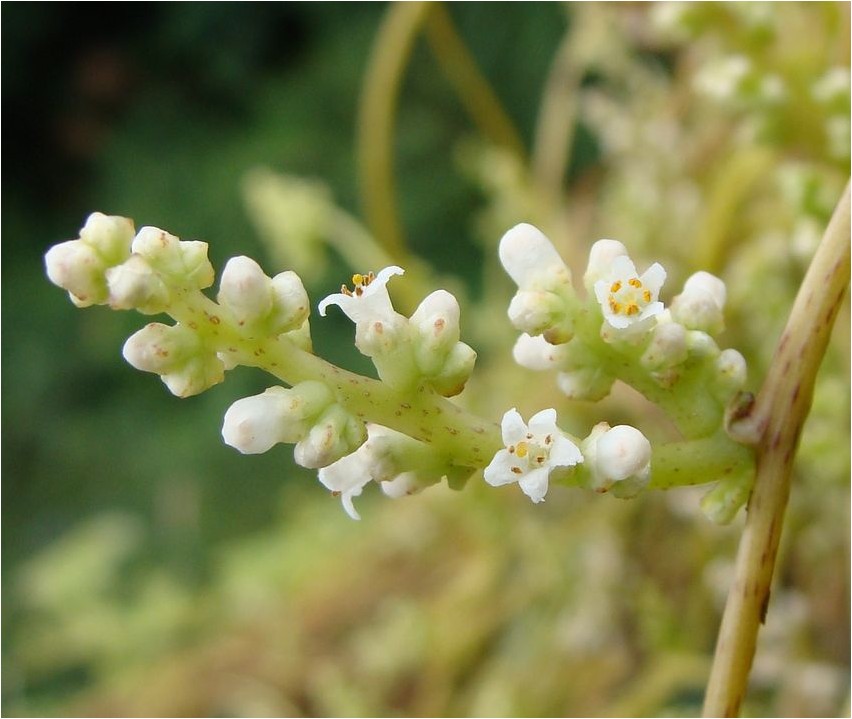
Japanese dodder is one of the plants of the family called dodder; in Latin the name of this plant will be as follows: Cuscuta japonica Choisy.
As for the name of the Japanese dodder family itself, in Latin it will be: Cuscutaceae Dumort.
Description of Japanese dodder
Japanese dodder is an annual herbaceous plant. The stems of such a plant are thick and fleshy, as well as branched, cord-like, bare, smooth, they reach two millimeters in diameter, and are colored more or less reddish. The flowers of Japanese dodder are yellow in color, their length is four millimeters, they will be sessile and collected in bunches into racemose inflorescences, which in turn will be three centimeters long. The corolla of this plant is short-bell-shaped, it can be either twice or even longer than the calyx itself, such a corolla will be colored in pinkish tones, and the capsule of the Japanese dodder is oval-ovate or oval, its length is equal to four millimeters. Such a box will be more or less colored, as well as one- and two-seeded. The seeds of this plant are round-heart-shaped, their length is two millimeters and their width is two and a half millimeters.
This plant blooms in August, while the fruits will ripen in October. Under natural conditions, Japanese dodder is found in the Far East: namely, in the west and south of Primorye and the Amur region. To grow, this plant prefers bush thickets, meadows, river valleys, and will also parasitize perennial herbaceous plants and shrubs.
Description of the medicinal properties of Japanese dodder
Japanese dodder is endowed with very valuable healing properties, and it is recommended to use the seeds of this plant for medicinal purposes.
The presence of such valuable healing properties should be explained by the content of coumarin umbelliferone, the flavonoid quercetin 3-glycrside, phenolcarboxylic acids and their derivatives in this plant.

A decoction made from Japanese dodder seeds has become quite common in Chinese medicine. This remedy is used to treat leprosy, including tuberculoid leprosy. In Korean medicine, a decoction made from this plant is used for cystitis, diabetes, threatened miscarriage, leucorrhoea, otitis, dizziness, neurasthenia, wet dreams, prolonged diarrhea, hysteria, and impotence, and is also used as a tonic.
Notably, clinical trials have shown that a decoction made from Japanese dodder seeds has beneficial properties in the treatment of diabetes. This is a combined remedy, the main ingredient of which is the seeds of this plant. Furthermore, a decoction of Japanese dodder seeds has the ability to increase agglutinogens in the blood and will have an immunostimulatory effect. For wet dreams, the following highly effective remedy based on this plant is recommended: to prepare this remedy, finely grind Japanese dodder seeds, Chinese wolfberry, dried raspberries, Schisandra chinensis, and plantain seeds. Take five to six grams of this remedy three times daily. Furthermore, this Japanese dodder-based remedy can be used as a tonic: it is highly effective when used correctly and properly.
Japanese dodder





