Coastal spurge
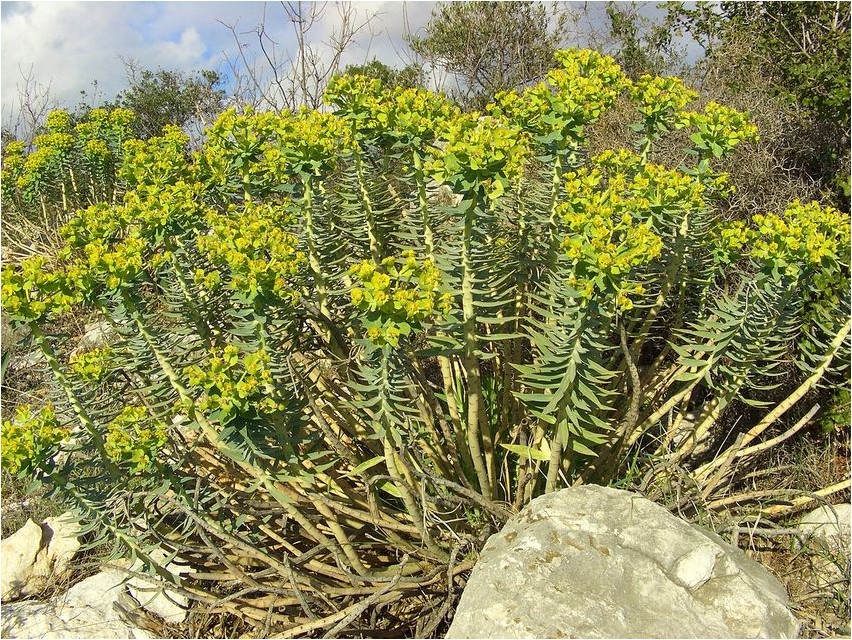
Coastal spurge is one of the plants of the family called Euphorbiaceae; in Latin the name of this plant will be as follows: Euphorbia fluviative L.
As for the name of the coastal milkweed family itself, in Latin it will be: Euphorbiaceae Juss.
Description of coastal milkweed
Coastal spurge is a perennial herbaceous plant whose height will range between thirty and eighty centimeters. This plant is bare and gray. The root of this plant will be long, many-headed and branched, the stems will be present in large numbers, they are hard, erect and densely leafy, and will also be endowed with six to eight axillary flower stalks. The apical peduncles of coastal milkweed can be from three to five pieces; they are thick and bifid two or three times. The involucre leaves of this plant will be ovoid, their length is about two centimeters, and their width will be approximately three to six centimeters. There are only two involucre leaves of this plant and they are kidney-shaped. The glass of coastal milkweed will be broadly bell-shaped, its length and diameter are approximately two to two and a half millimeters, while the inside of such a glass will be hairy. The three-nut of this plant is strongly flattened and turnip-shaped, while the seed will be ovoid-spherical and whitish in color.
Coastal milkweed bears fruit during the period from July to August. Under natural conditions, this plant is found in the Caucasus and Crimea. To grow, coastal spurge will prefer sands and places near the seashore.
Description of the medicinal properties of coastal milkweed
Coastal euphorbia is endowed with very valuable healing properties, and for medicinal purposes it is recommended to use the entire above-ground part of this plant and its milky juice.
The presence of such valuable healing properties should be explained by the content in this plant of saponins, alkaloids, rubber, diterpenoids, triterpenoids, tannins, higher aliphatic carbohydrates, flavonoids, an unidentified alcohol with a melting point of seventy-nine degrees, as well as the steroids sitosterol, cholesterol, campesterol, lanosterol and stigmasterol.

The aerial parts of this plant contain coumarins, while the leaves contain sitosterol, esquitin, flavonoids, pinecolic acid, triterpenoids, and the higher aliphatic hydrocarbon triacontane. The seeds contain fatty oil.
In folk medicine, Euphorbia riparia is quite widespread here. This medicinal plant is used as an infusion prepared from the herb to treat anthrax, while the milky juice is used to remove nasal polyps, lipomas, calluses, and warts.
A decoction prepared from the roots of this plant is recommended as a laxative and is also used to treat rabies. Externally, these remedies are used as poultices and to treat wounds. A decoction of this plant’s herb is also used as a very effective laxative, while an infusion is used for various heart ailments and jaundice. It’s worth noting that the above-ground parts of the coastal spurge can dye silk and wool green, yellow, and black. It’s important to remember that the milky sap of this plant will irritate the skin, and if ingested, it will irritate the mucous membranes.