Goat willow
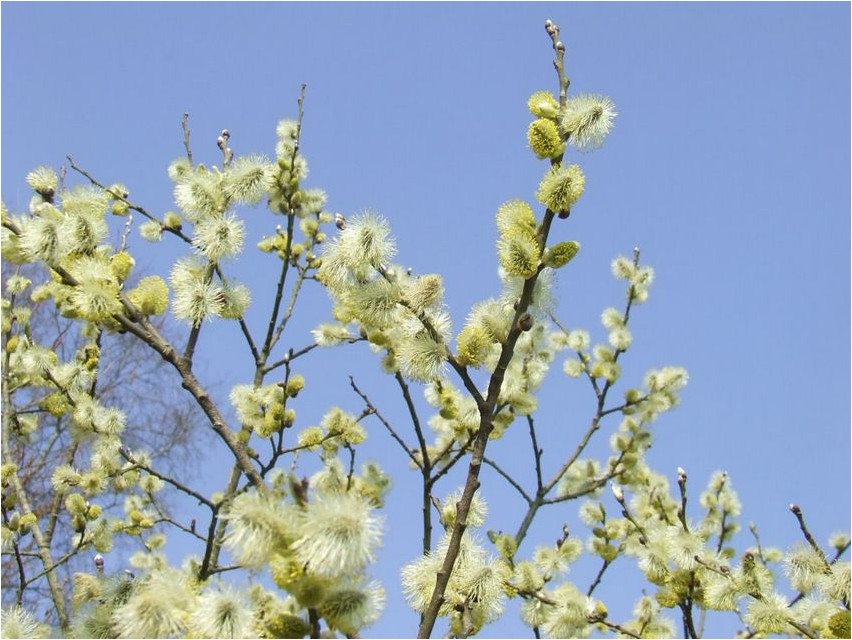
Goat willow is a member of the Salix family, and its Latin name is Salix caprea L.
The Latin name for the goat willow family is Salicaceae Mirb.
Description of Goat Willow
Goat willow is a dioecious tree with greenish-gray bark, reaching heights between six and ten meters. Its leaves are alternate, ovate-oblong in shape, tomentose beneath, and dark green in color. The male catkins are yellow, and the pistillate catkins are quite long. The fruit is a capsule. Flowering occurs in May before the leaves emerge. In the wild, this plant is found in the European part of Russia, Siberia, Belarus, the Far East, and the Caucasus. Goat willow prefers forests, shrubby areas, and forest edges.
Description of the medicinal properties of goat willow
Goat willow possesses valuable medicinal properties. These valuable medicinal properties are explained by the plant’s content of tannins, flavonoids, salicin, ascorbic acid, organic acids, bitter substances, and resinous substances.
The leaves of this plant contain bitter substances, tannins, flavonoids, salicin, resinous substances, and ascorbic acid. Goat willow inflorescences contain tannins, flavonoids, ascorbic acid, bitter substances, resinous substances, salicin, organic acids, and organic substances. A decoction made from the roots of this plant has antipyretic, diuretic, diaphoretic, wound-healing, antimalarial, and anti-inflammatory properties. The decoction is recommended for lung conditions, coughs, colds, headaches, inflammatory gastrointestinal diseases, and is also used as a mouthwash and throat rinse for stomatitis and numerous inflammatory conditions.
The bark and stems of goat willow are recommended to be used as a hemostatic and astringent, as well as for hemorrhoids and diarrhea. The bark powder of this plant is used as a wound-healing agent; this powder is used to sprinkle wounds and use it for furunculosis, skin diseases and rheumatism. The bast should be applied to the burned areas of the skin, and the juice of the heated young branches is recommended to lubricate the calluses. A decoction of the bark of this plant can be used to wash your feet when they are sweating.

It has been officially confirmed that athlete’s foot is cured through hot baths from willow bark. A decoction prepared from goat willow bark should be used as a gum strengthening agent, and also as an anthelmintic and sedative for various neuropsychic disorders.
The oil obtained by distilling goat willow leaves is recommended for use as a tonic and a remedy that can increase the sexual activity of the product. The infusion and tincture obtained from the male inflorescences of this plant are valuable cardiac remedies that can be effective in treating tachycardia, cardiac arrhythmia, and will also regulate the neuromuscular apparatus of the heart. It should be noted that a decoction prepared from goat willow stems is a very valuable remedy for stopping hair loss.
It is noteworthy that in the future, new ways of using the healing properties of this plant may emerge, because its chemical composition has not yet been fully studied.
Goat willow: review of the variety, favorite pests and subtleties of care
Goat willow


