Late rattle
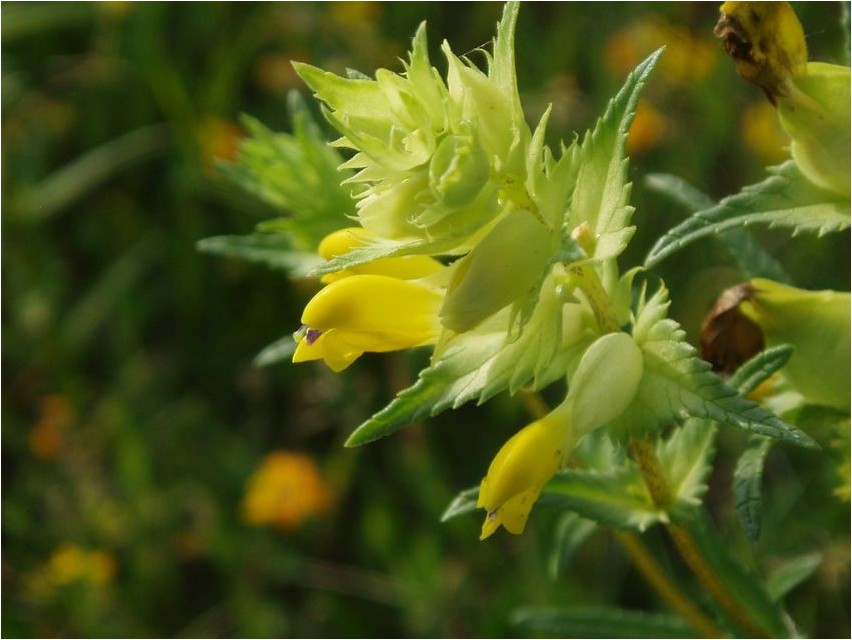
Late rattle is one of the plants of the family called Noricaceae; in Latin the name of this plant will be as follows: Rhinanthus serotinus (Schoenh.) Oborny (R. angustifolius Gmel., R. major Ehrh., R. montanus Saut.).
As for the name of the late rattle family itself, in Latin it will be like this: Scrophulariaceae Juss.
Description of the late rattle
Late rattle is an annual herbaceous plant, the height of which can reach up to one hundred centimeters. It is noteworthy that such a plant is a semi-parasite. The stem of the late rattle is straight, from the very middle such a stem will be highly branched and almost bare, while the branches of such a stem will be directed obliquely upward and will be more or less often purple-colored. The leaves of the late rattle turn out to be longer than the stem internodes; they are linear-lanceolate or lanceolate, while the internodes will be quite numerous: from fifteen to thirty pieces. The corolla of the late rattle is painted in yellow tones, its length is sixteen to eighteen millimeters, it is endowed with a slightly curved tube, and the upper lip of this plant is endowed with a purple nose, and its length slightly exceeds one millimeter. The late rattle capsule will be round in shape, its length and width are nine to ten millimeters, and the length of the seeds is approximately three to four millimeters, and the width is almost identical.
The late rattle blooms from August to October. Under natural conditions, this plant is found in the territory of Ukraine, the Caucasus, Belarus, all regions of the Far East, with the exception of the Okhotsk region, as well as the Upper Tobolsk and Irtysh regions of Western Siberia, in all regions of the European part of Russia, except for the Lower Volga region. For growth, this plant prefers places among bushes, sand, steppes and pine forests. It is noteworthy that the late rattle is an insecticide and is also a poisonous plant.
Description of the medicinal properties of late rattle
Late rattle is endowed with very valuable healing properties, and it is recommended to use the herb of this plant for medicinal purposes.
The presence of such valuable medicinal properties is believed to be attributed to the plant’s content of alkaloids, iridoids, benzoic acid, flavonoids, beta-sitosterol, as well as the following phenolic acids and their derivatives: chlorogenic, ferulic, and caffeic. A decoction made from the herb is recommended as a diuretic and analgesic, and is also used for alcoholism, gastralgia, coughs, headaches, leucorrhoea, diarrhea, and jaundice.

It should be noted that, as a preventative measure against hypothermia, the skin should be rubbed with crushed rattle, previously mixed with honey.
For coughs and colds, the following highly effective remedy based on this plant is recommended: to prepare this remedy, take one teaspoon of crushed dried rattle per two glasses of water. The resulting medicinal mixture is recommended to be boiled for approximately three to four minutes, then left to steep for approximately one hour, after which the herbal remedy should be thoroughly strained. Take one tablespoon of the resulting medicinal remedy three to four times daily.