Arceutobium juniper
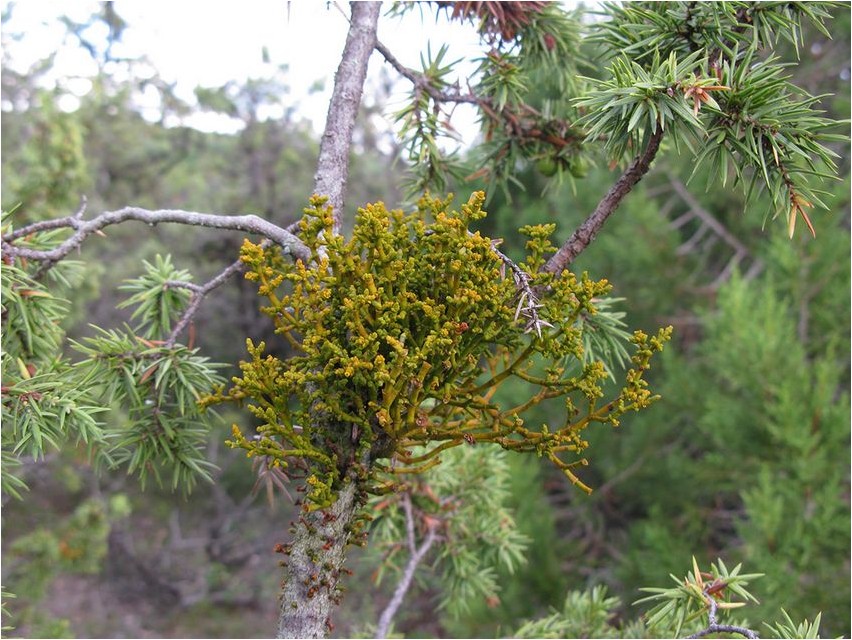
Arceutobium juniper belongs to the family called Limnifloraaceae. The Latin name of this family is: Loranthaceae Juss.
Actually, it should be noted that Arceutobium is a genus of semi-parasitic shrubs and herbs. This plant is sometimes classified as a member of the family called Santalaceae, although the plant was previously considered to be a member of the mistletoe family. In science, there is a synonym for the name of this plant, which sounds like this: Razoumofskya Hoffm. Popularly, Arceutobium juniper is sometimes also called a juniper eater.
There are only three species of this plant. The first species is called Arceutobium americana, the second species is simply called Arceutobium or dwarf mistletoe, and the third species is called Arceutobium juniper. It is worth noting that the third type is the most common in nature.
Arceutobium juniper is a rather small shrub, the height of which ranges from twenty to thirty centimeters. This plant itself is bare, its branches are compressed and segmented. The leaves of this plant are small in size. Arceutobium has single flowers in the axils of the leaves, which will be unisexual and dioecious. Staminate flowers have two to five separate limbs. The flowers themselves are pistillate and are endowed with a bipartite perianth. In addition, there is also a false fruit, which in appearance is very reminiscent of a berry. This fruit itself is bluish in color and ovoid. The branches of the plant are woody, and the leaves themselves are quite small and scale-like, and also sitting in pairs.
Under natural conditions, this plant can be found in the Crimea, as well as in the Caucasus and Central Asia. This plant naturally parasitizes on the roots of junipers, which actually explains the name of this plant. In nature, Arceutobium juniper grows at an altitude of approximately two to two and a half thousand meters above sea level. As for Central Asia, this plant is found only in the mountains; Arceutobium juniper can also be found in Turkish Armenia, Kurdistan, Iran, the Himalayas and the Balkan Peninsula. This plant also grows in the southern territories of Central Europe.
Medicinal properties of Arceutobium juniper

Arceutobium juniper has unique medicinal properties. It is noteworthy that the stems and leaves of this plant are used for medicinal purposes. Such valuable properties of Arceutobium juniper are explained by the content of saponin, alkaloids, as well as flavonoids in the form of myricetin and quercetin in this plant. This plant also contains the following actocyanins: delphinidins and cyanidins, and in addition also leucoanthocyanins.
This plant is also endowed with proteocidal properties. The aqueous extract of this plant is believed to cause instant suspension and even death of ciliates. A decoction of the leaves and stems of Arceutobium juniper is very often used as an anticonvulsant, while the powder of the fruit is sometimes also used for abscesses of varying degrees of complexity.
In order to prepare a decoction of Arceutobium juniper as an anticonvulsant, you will need to take one tablespoon of crushed dry stems and leaves of the plant per glass of water. The resulting mixture should be boiled for five minutes, then left to steep for one hour, and then strain the decoction. It is recommended to take one or two tablespoons of this decoction two or three times a day.





