Rose apple
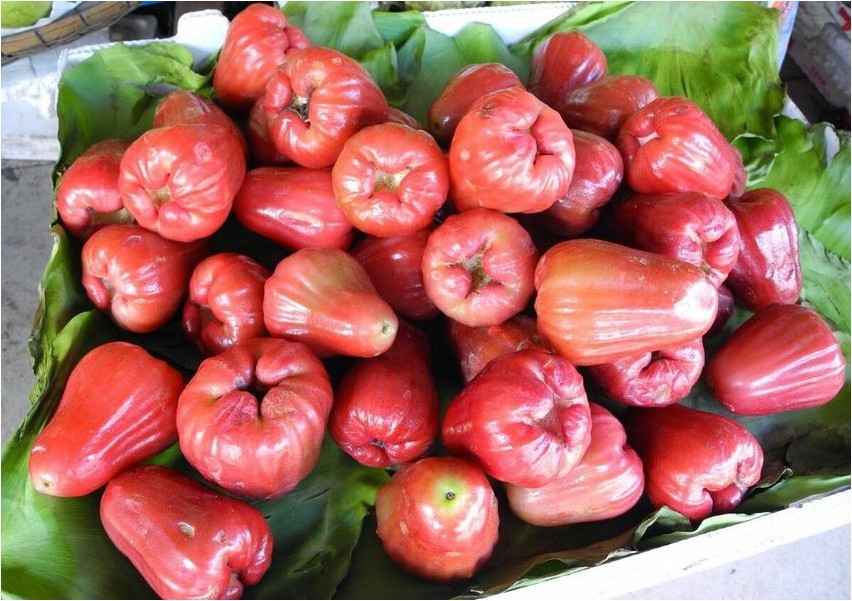
Rose apple (lat. Syzygium jambos) is a fruit crop representing the Myrtaceae family. Quite often it is called Malabar plum.
Description
The rose apple is a fruit tree with a very dense crown, the height of which can reach twelve meters.
The leathery and lanceolate or elliptical leaves of this culture are always glossy and colored in rich dark green tones. They grow from ten to twenty-two centimeters in length, and their width is from 2. 5 to 6. 25 cm. Freshly blossomed leaves boast a pleasant pink color — only after some time do they turn green.
And the width of the creamy or greenish-white flowers of the pink apple is in the range from five to ten centimeters.
The fruits of this crop can be round, oval or pear-shaped, and their average length is four to five centimeters. The upper parts of these attractive fruits are covered with rather hard green cups. Their skin is very smooth and thin, pale yellow or white, with a characteristic pinkish coating. And the pulp contained inside the fruit is usually crispy, sweetish and loose. In addition, it boasts a charming rose aroma (it is this fact that gives rise to the name of the culture). The pink apple owes such an attractive smell to ethylene — this chemical compound is produced by trees in order to attract various fruit-eating animals (mostly elephants) and birds, which will subsequently spread it.
In the center of the fruit pulp there are cavities containing one to four brownish seeds 1 to 1. 6 cm long. These seeds are not digested after entering the stomachs of birds or animals. Under favorable conditions, a pink apple will produce fruit throughout the year, with its peak fruiting invariably occurring only in three or four months.

Where does it grow
The plant”s homeland is Eastern India and colorful Malaysia. For a long time it has been cultivated in Sri Lanka, as well as in Indochina and on a number of picturesque Pacific islands. In 1762, this culture came to Jamaica, from where it gradually began to penetrate into Bermuda, the Bahamas, and the Antilles. The flat part of both Central and South America (in the direction from Southern Mexico to Peru) did not remain uncovered. And in Australia and on the African continent (in the tropical zone), this plant is considered an agricultural crop.
Uses
These attractive fruits are most often eaten fresh, as they are very easily digested and provide the body with a wealth of beneficial nutrients. They are best eaten with the skin, as this is where most of the vitamins are found. Rose apples also make excellent fruit syrups, sauces, and jams and jellies.
The abundance of moisture and delicate fiber makes rose apples an excellent remedy for constipation, and they are also excellent for normalizing intestinal microflora. Residents of Malaysia and India are convinced that there is simply no better thirst quencher in the heat. And just one fruit is enough!
Furthermore, the flesh of rose apples has powerful antiseptic properties, allowing it to quickly and mercilessly combat pathogenic fungi and bacteria. The leaves of this plant yield juice used as a facial lotion—this product helps moisturize and nourish the skin, as well as smooth out wrinkles. The leaves have also found application in cosmetology and perfumery, yielding valuable essential oil. The tree bark, rich in tannins, has been used for tanning leather since ancient times.
Contraindications
No contraindications to rose apple consumption have been identified at this time—it can be consumed safely by people of any age and condition, including pregnant women and nursing mothers. However, a certain amount of caution is still advisable when first encountering this exotic fruit—limiting yourself to a single fruit is sufficient to begin with.