elephant apple
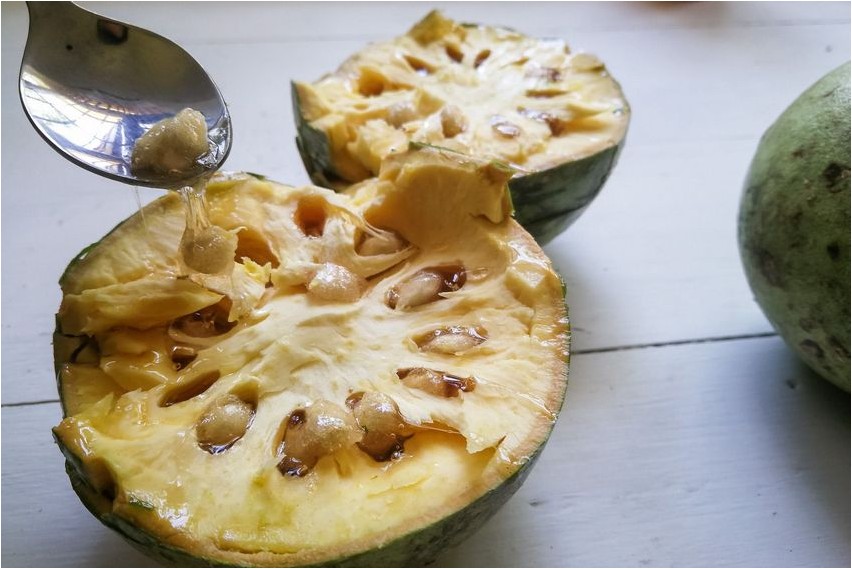
Elephant apple (lat. Dillenia indica) is a fruit tree belonging to the Dillenia family (one of the rarest). In science, this culture is called Indian Dillenia.
Description
The elephant apple is an evergreen fruit tree, endowed with an orangeish-brown or strong reddish trunk and a rounded and very spreading crown. The height of most trees rarely exceeds fifteen meters, but sometimes you can find individual trees growing up to thirty meters.
The dark green leaves of the elephant apple grow from fifteen to thirty-six centimeters in length and are equipped with clearly visible veins and a grooved surface. Such leaves are located exclusively on the tops of the branches (at the same time as single flowers).
Incredibly fragrant and amazingly beautiful elephant apple flowers are quite large in size: their diameter often reaches fifteen to twenty centimeters. Each flower is equipped with many yellow stamens and fancy white petals.
The first flowers of the elephant apple begin to appear when it reaches the age of three to four years. And then throughout the rest of your life (which is more than fifty years), this plant will delight you with its amazing daily flowering. It is noteworthy that the same inflorescence can include not only open flowers, but also buds, and sometimes even fruits. Each flower begins to bloom at night, around 03:00, and about an hour before the sun rises, all the flowers finally bloom. And already in the afternoon, at approximately 15-16 hours, the petals of the wonderful flowers completely fall off. It turns out that it takes no more than half a day for one flower to bloom.
The complex fruits of the elephant apple are formed by fifteen greatly enlarged carpels. Inside each fruit there are five seeds, surrounded by fleshy, overgrown sepals. The diameter of elephant apples ranges from five to twelve centimeters, and in appearance they look like simple and familiar apples.

This unusual culture was first described by Carl Linnaeus. He also gave this plant a Latin name — in honor of his friend and part-time colleague from Oxford Dillenius.
Reproduction of the elephant apple can occur both through seeds and vegetatively (that is, separated root shoots).
Where does it grow
The elephant apple grows in Southeast Asia, as well as in Sri Lanka and India. It can also be found growing wild in Australia, distant Madagascar, and hot Africa. This attractive plant most often grows along rivers and tropical streams.
Uses
The flesh of the elephant apple is edible. It is especially widely used in Indian cuisine, where it is used to make a wide variety of desserts, jellies, and jams, as well as delicious preserves, various refreshing drinks, and the famous curry sauce. Unripe fruits are excellent for making rich pickles and chutneys.
Since the elephant apple is rich in iron, it is beneficial for heavy menstrual periods and anemia in women. It is also an excellent supportive remedy after significant blood loss during surgery or injury. The slightly sour taste of this fruit helps stimulate the appetite, normalizes intestinal microflora, improves digestibility, and has pronounced diuretic and choleretic properties. The tannins contained in the fruit inhibit putrefactive processes not only in the gastrointestinal tract but also in the oral cavity.
Wooden apple
https://www. youtube. com/watch? v=vsZz5_sYSv0
Elephant apple